
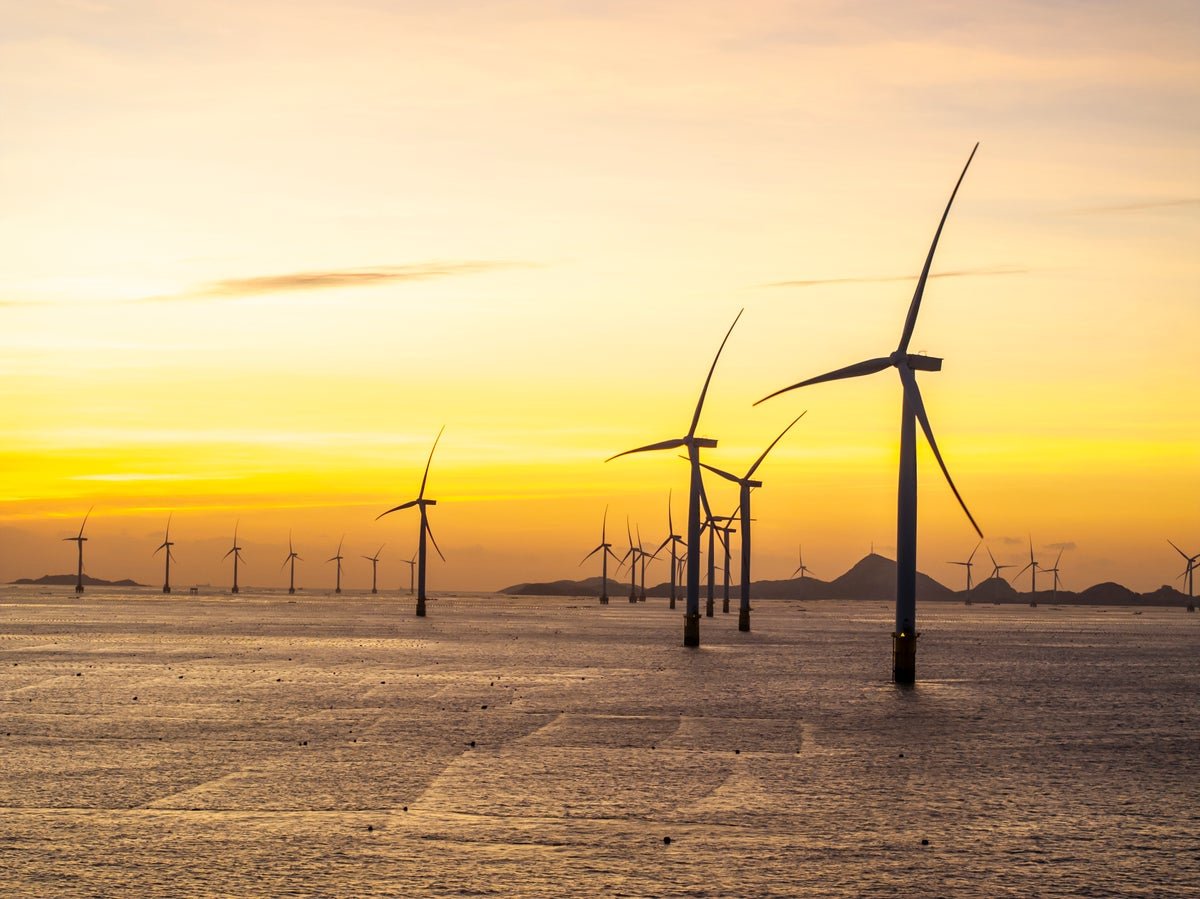

Offshore Wind Farm in China Becomes a Haven for Oysters, Barnacles, and More, Study Finds
A wind farm off the coast of China appeared to boost fish numbers and supported colonies of oysters and barnacles, according to new research

Offshore wind farms may do more than boost renewable energy: they might support marine ecosystems, too. That’s the takeaway of a new study conducted in China. The researchers found that wind turbines provided support for colonies of oysters and barnacles and that fish species and biomass were more abundant near the turbines than they were in an area without the machines.
The study counters a frequent criticism of offshore wind farms—that they are detrimental to marine life and may damage the seabed. China, while being the world’s biggest emitter of greenhouse gases, is a global leader in renewable energy build-out, including offshore wind projects. It has the largest wind power capacity of any nation and plans to build the world’s largest wind turbine.
Located in China’s northern Yellow Sea, the wind farm evaluated in the study gave rise to a so-called benthic ecosystem—one dominated by seafloor organisms—that was nonexistent in a comparable area nearby that had no turbines. The researchers think the rough turbine surfaces provided an optimal habitat for such organisms.
On supporting science journalism
If you’re enjoying this article, consider supporting our award-winning journalism by subscribing. By purchasing a subscription you are helping to ensure the future of impactful stories about the discoveries and ideas shaping our world today.
Because these organisms were able to grow and thrive on and around the turbines, predatory fish followed the food, boosting the ecosystem’s diversity and stability overall, said James Tweedley, a senior lecturer at Murdoch University in Australia and a co-author of the study, in a recent statement.
It’s Time to Stand Up for Science
If you enjoyed this article, I’d like to ask for your support. Scientific American has served as an advocate for science and industry for 180 years, and right now may be the most critical moment in that two-century history.
I’ve been a Scientific American subscriber since I was 12 years old, and it helped shape the way I look at the world. SciAm always educates and delights me, and inspires a sense of awe for our vast, beautiful universe. I hope it does that for you, too.
If you subscribe to Scientific American, you help ensure that our coverage is centered on meaningful research and discovery; that we have the resources to report on the decisions that threaten labs across the U.S.; and that we support both budding and working scientists at a time when the value of science itself too often goes unrecognized.
In return, you get essential news, captivating podcasts, brilliant infographics, can’t-miss newsletters, must-watch videos, challenging games, and the science world’s best writing and reporting. You can even gift someone a subscription.
There has never been a more important time for us to stand up and show why science matters. I hope you’ll support us in that mission.

