


Listen to the oldest known recording of a whale
Researchers have rediscovered a 77-year-old recording of a haunting song that now has been determined to have come from a humpback whale
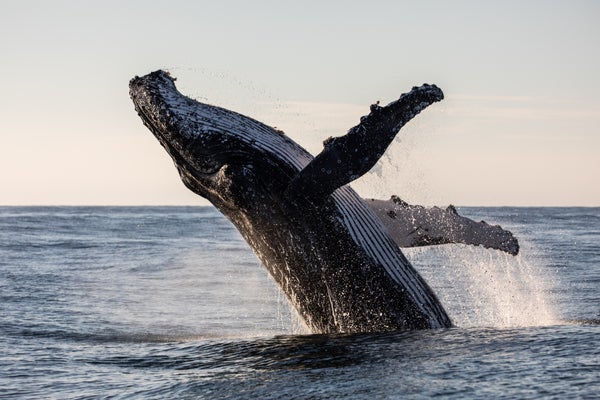
Marnie Griffiths/Getty Images
On March 7, 1949, researchers at the Woods Hole Oceanographic Institution (WHOI) were stationed on a boat called the R/V Atlantis that was sailing off the coast of Bermuda.
They lowered a primitive underwater recording setup into the ocean, and a boxy machine more regularly found in offices began etching the sounds of the sea—a chorus of eerie howls and rustling waves—into a thin plastic disk. That disk made its way to WHOI’s archives in Massachusetts, where it sat, an overlooked relic of the earliest days of underwater acoustic recording.
On supporting science journalism
If you’re enjoying this article, consider supporting our award-winning journalism by subscribing. By purchasing a subscription you are helping to ensure the future of impactful stories about the discoveries and ideas shaping our world today.
Fast-forward nearly eight decades, and experts at WHOI have rediscovered the recording and determined it’s probably the oldest whale recording still in existence. The likely vocalist? A humpback whale (Megaptera novaeangliae).
The scientists who stumbled on the rare recording are eager to use it for science.
“Data from this time period simply don’t exist in most cases,” said Laela Sayigh, a marine bioacoustician at WHOI, in a statement. “This recording can provide insight into how humpback whale sounds have changed over time, as well as serving as a baseline for measuring how human activity shapes the ocean soundscape.”
The recording dates to a time when the North Atlantic Ocean’s humpback whales were struggling because of decades of commercial whaling. By 1955, the population had likely fallen below 1,000 animals, experts have since estimated. And although humpback whales are due for a thorough census, even outdated estimates suggest there are at least 20 to 25 times the number of these animals in the region today.
But there are still concerns about the whales and other marine species because of shipping and water pollution, as well as noise pollution, which is thought to interfere with the whales’ ability to “talk” to one another through their songs.
Humpback whales are found in every ocean and take one of the longest migrations of any mammal, swimming 5,000 miles from the tropical waters where they breed to colder waters where they feast on krill and small fish that they filter through the sievelike baleen plates in their mouth.
It’s Time to Stand Up for Science
If you enjoyed this article, I’d like to ask for your support. Scientific American has served as an advocate for science and industry for 180 years, and right now may be the most critical moment in that two-century history.
I’ve been a Scientific American subscriber since I was 12 years old, and it helped shape the way I look at the world. SciAm always educates and delights me, and inspires a sense of awe for our vast, beautiful universe. I hope it does that for you, too.
If you subscribe to Scientific American, you help ensure that our coverage is centered on meaningful research and discovery; that we have the resources to report on the decisions that threaten labs across the U.S.; and that we support both budding and working scientists at a time when the value of science itself too often goes unrecognized.
In return, you get essential news, captivating podcasts, brilliant infographics, can’t-miss newsletters, must-watch videos, challenging games, and the science world’s best writing and reporting. You can even gift someone a subscription.
There has never been a more important time for us to stand up and show why science matters. I hope you’ll support us in that mission.

