
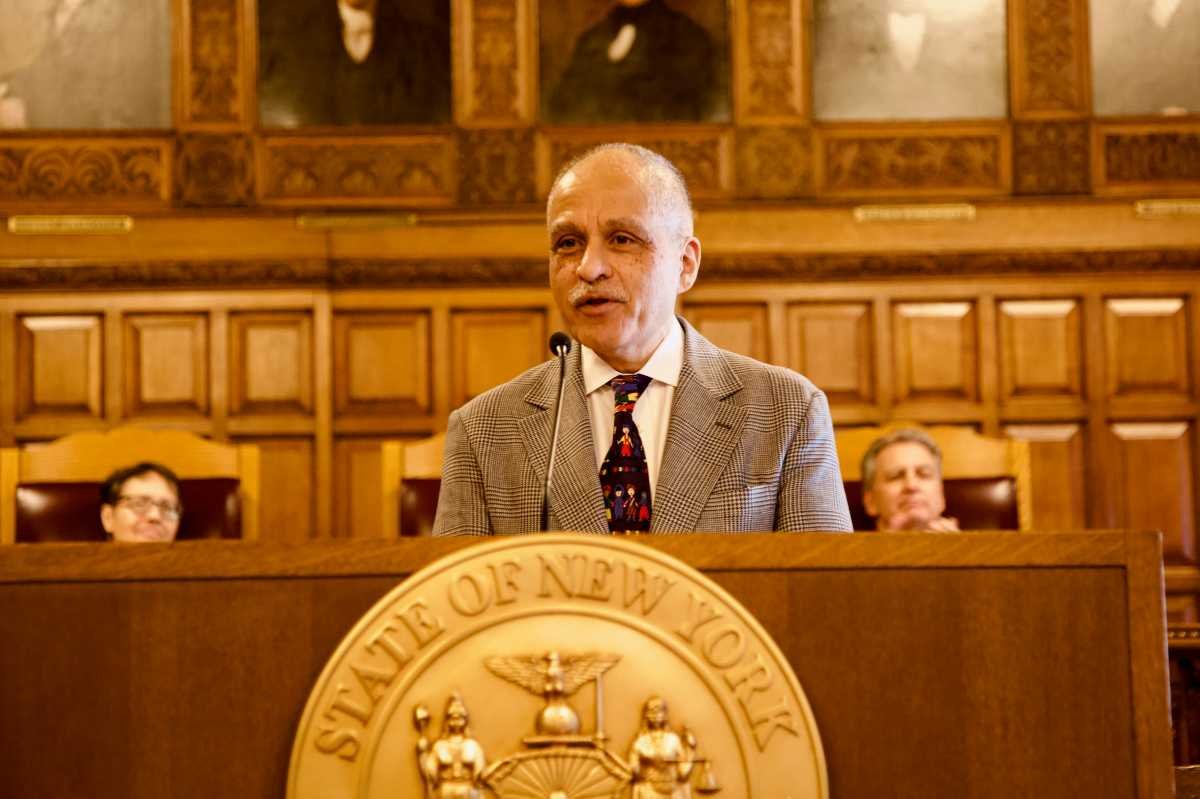
New York state Chief Judge Rowan D. Wilson focused his 2026 State of the Judiciary speech on the needs of the family court system.
Photo by Max Parrott
There’s an old saying in the language Yorùbá, which is spoken in parts of Western Africa, “Àwọn ọmọ ńkò?” — or, “How are the children?”
It’s a sentiment that connects childhood wellbeing to a society’s future, Family Court Judge Fatimat Reid said Monday in an address at Court of Appeals Hall in Albany as part of the New York court system’s annual State of the Judiciary.
This year, New York Chief Judge Rowan Wilson focused his remarks on the needs of the state’s family courts.
During his addresses, Wilson laid out his vision for the part of the system that handles issues like child custody, visitation, adoption and domestic violence — “the most intimate, and often most sorrowful and traumatic periods of life,” he said.
The topic is not new to Wilson, who has focused on improving the “overburdened and under-resourced” family court system since his confirmation in 2023. But his emphasis comes after the court system requested a budget increase request that includes over $12 million for various family court initiatives like mediation services, peer advocacy for parents and youth and mental health pilots.
Wilson noted that serving New York’s families goes beyond the court system — the need for services often stems from deep-seated issues like systemic poverty and mental illness, he said.
“The court system’s goal is to provide not just robust judicial resources that can help get families to a place of stability and safety, but also to partner with New York’s other branches of government and local communities to provide support for our families’ needs before, during, and after their time in family court,” Wilson said during his speech.
The problems with New York’s family court system are well-documented. A 2024 report by the state Senate Committee on Judiciary found that the courts often fail to adequately retain staff and hear cases in a timely manner.
Besides big-picture questions about how the branches of state government need to work together in order to improve family court outcomes, Wilson emphasized the system’s need to “expand resources” to dedicate time for a “tailored approach” to family court cases.
While his budget has proposed an additional $4.2 million for Attorney for Child providers — the legal defenders who represent children involved in family court proceedings — it’s a far cry from the $60 million for AFCs that advocates have estimated is necessary to correct for the delays in family court.
In spite of that, his efforts have drawn the support of those advocates. Liberty Aldrich, a former judge who now leads the group that came up with the $60 million figure and spoke as part of the program, commended Wilson on his efforts to push for funding for services outside the court system.
“Judge Wilson has been unbelievable,” said Aldrich. “The idea of fully funding community-based services, which is what he’s talking about, is completely necessary… We also need attorneys for all children in family court, which we don’t have.”
As in years past, the program featured a series of advocates and New Yorkers who have had their lives changed for the better and worse by the family court system.
A mother whose youth in the foster care system was marred by sexual abuse testified about her path to becoming to a parent advocate at a foster care agency. Another parent testified about her legal battle to regain custody of her children after they were removed from her care based on allegations of severe abuse that turned out to be unfounded.
“During the court process, I felt like I was guilty until I could prove myself innocent,” said Sarai Mejia about her custody case.
In addition to calling for more funding, Wilson took stock of his accomplishments in family court. Under his tenure, the state legislature and governor have created 29 new family court judgeships in the state, appointed 10 new family court magistrates in New York City and increased nonjudicial staffing by 21% in the past two years.
As part of his call for more reforms, Wilson used a symbol of an ornate grandfather clock in the Court of Appeals courthouse on the event’s program in order to symbolize the urgency of family court cases.
“With children, time is especially valuable, and delays are especially harmful,” Wilson said at the close of his remarks. “Any period of family separation feels like an eternity; any delay in a hearing, trial, adjudication or appeal can disrupt foundational relationships, destabilize a life or forfeit a chance to prevent or repair damage.”

