

A boom in gravitational waves leaves scientists with more questions than answers
A new data release more than doubles the number of gravitational-wave candidate events—and reveals unexpected complexities of merging black holes
An artist’s concept of a binary black hole merger, in which the black holes have misaligned spins with respect to one another. Such details can be revealed by gravitational waves emitted during a merger, and complicate the theoretical picture of how these types of binaries form.
Carl Knox, OzGrav, Swinburne University of Technology
A soaring cosmic symphony surrounds us; its notes emerge from massive celestial objects crashing together hundreds of millions or even billions of light-years away. But scientists have only tuned into this music of the spheres for about a decade, thanks to sophisticated observatories that were custom-built to pick up these reverberations—gravitational waves—which ripple otherwise unnoticed through the fabric of spacetime. And with each newfound note, the symphony becomes more complex—and, for now, perhaps more confusing.
Ever since astronomers announced the first gravitational-wave detection in 2016, they’ve been carefully fine-tuning their detectors to pick up on more mergers. Today four facilities combine to form a global network of observatories—namely, the two stations of the Laser Interferometer Gravitational-Wave Observatory (LIGO) in the U.S. and the single stations of Virgo and the Kamioka Gravitational-Wave Detector (KAGRA) in Italy and Japan, respectively. The LIGO-Virgo-KAGRA (LVK) collaboration has proved especially successful in the past few years; the network’s fourth observation period yielded more gravitational-wave detections than the previous three combined. The total number of observed candidate events is up to 218, according to a catalog released earlier this month.
“We’re learning a lot of things that are qualitative and phenomenological from the catalog,” says Jack Heinzel, a member of the LVK collaboration and a doctoral physics student at the Massachusetts Institute of Technology.“Starting to see all these different structures emerge is pretty fascinating.”
On supporting science journalism
If you’re enjoying this article, consider supporting our award-winning journalism by subscribing. By purchasing a subscription you are helping to ensure the future of impactful stories about the discoveries and ideas shaping our world today.
Researchers are excited about gravitational waves because these spacetime ripples constitute an entirely new way to study the universe, independent of the electromagnetic radiation (light) upon which most other astronomical observations rely. Sloshing out from the inaccessible hearts of collapsing stars and from the tumultuous spacetime churnings of merging black holes and neutron stars, gravitational waves provide deep, fundamental insights about these faraway astrophysical systems that are otherwise unavailable. But analyzing the gravitational waves from these events is still leaving researchers with more questions than answers.
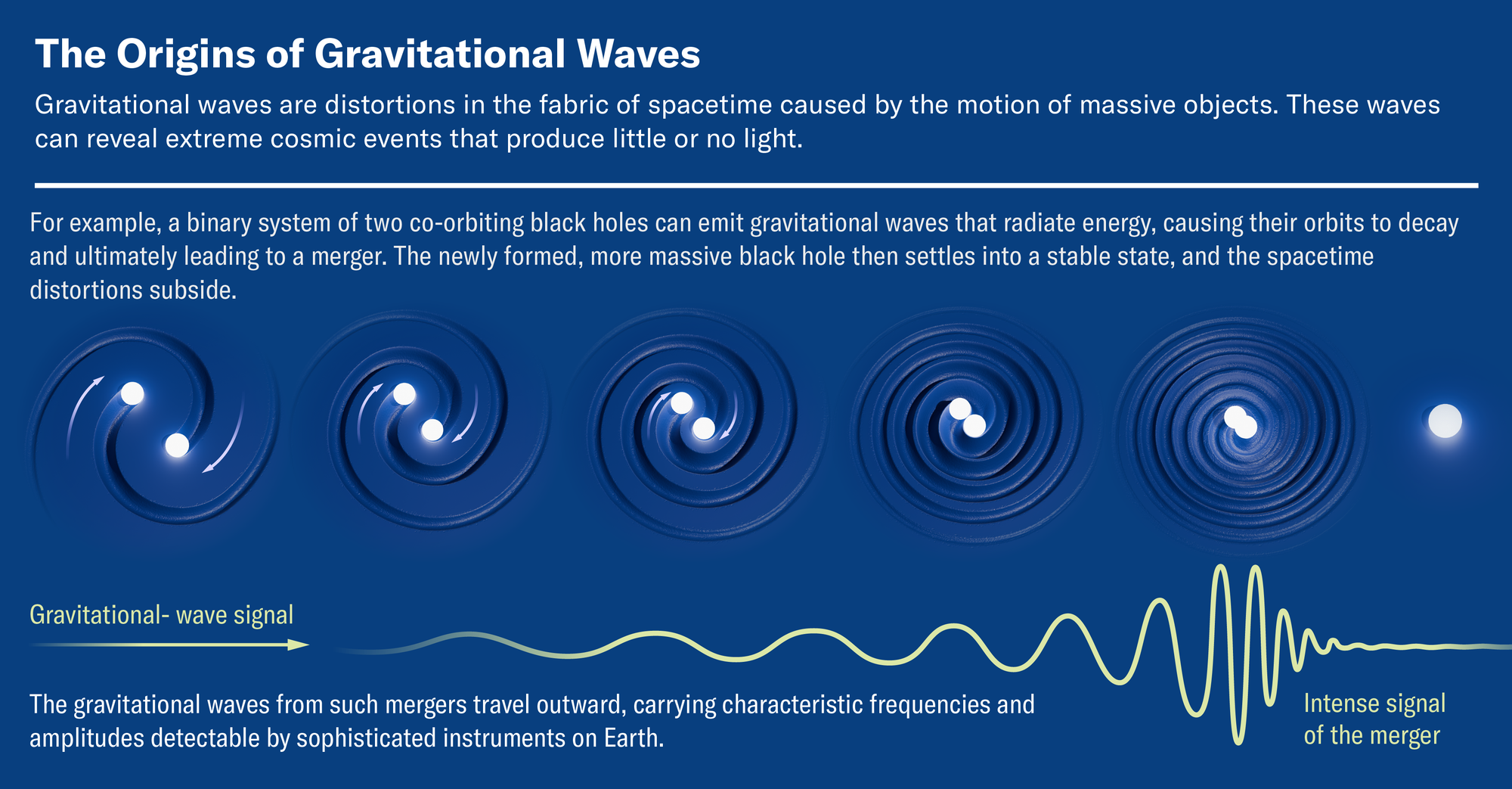
Waves produced by merging pairs of black holes, in particular, are a feast for data-hungry theorists. By divining the spins, orbits and masses of the progenitor black holes from their emitted gravitational waves, researchers can better understand how the black holes formed in the first place—and how they and the universe around them have subsequently evolved. Most of the merging black holes glimpsed by LVK are thought to have been born via the deaths of massive stars.
“Gravitational wave astrophysics is almost like paleontology,” says Ilya Mandel, a theoretical astrophysicist at Monash University in Australia. “Black holes are the fossils of the massive stars. We can rewind the clock and use that to learn something about how the stars lived.”
The catalog of observations now includes many “typical” gravitational-wave events—high-energy collisions between two black holes of around the same mass—as well as waves caused by unusual mergers.
Some of the catalog’s newest editions include GW231123, caused by the collision of two abnormally heavy black holes with an end mass approximately 225 times that of our sun; GW231028, a merger of two black holes in which each spins at about 40 percent the speed of light; and GW241011 and GW241110, each of which seems to have sprung from mergers where the progenitor black holes have been wildly mismatched in mass and in the alignment of their respective orbits and spins. These events all suggest intricate formation processes in which the black holes themselves formed through multiple earlier mergers.
Still, despite all these data, researchers say the field of gravitational-wave astronomy is at a point where the flood of discovery is providing more new possibilities rather than ruling out old ones.
“There are clues, but they are by far not a ‘smoking gun,’” says Salvatore Vitale, a member of the LVK collaboration and physicist at M.I.T. “Astrophysics is really messy, and so it turns out that there are several ways in which you can create these features.”
Researchers still haven’t pinned down the full range of celestial bodies whose mergers can produce gravitational waves detectable by LVK. They also haven’t reached consensus on what causes some of the unique features in atypical black holes, and just how much any given set of waves can reveal about its immediate cosmic surroundings.
Vitale notes that comprehending the complex formation of gravitational waves is “intrinsically a very hard problem” but that further observations should eventually provide the answers scientists need. The main obstacle is the pace of discovery, which is ramping up but still hindered by the LVK network’s limited sensitivity and the fact that the network has extensive, preplanned offline periods for maintenance and upgrades.
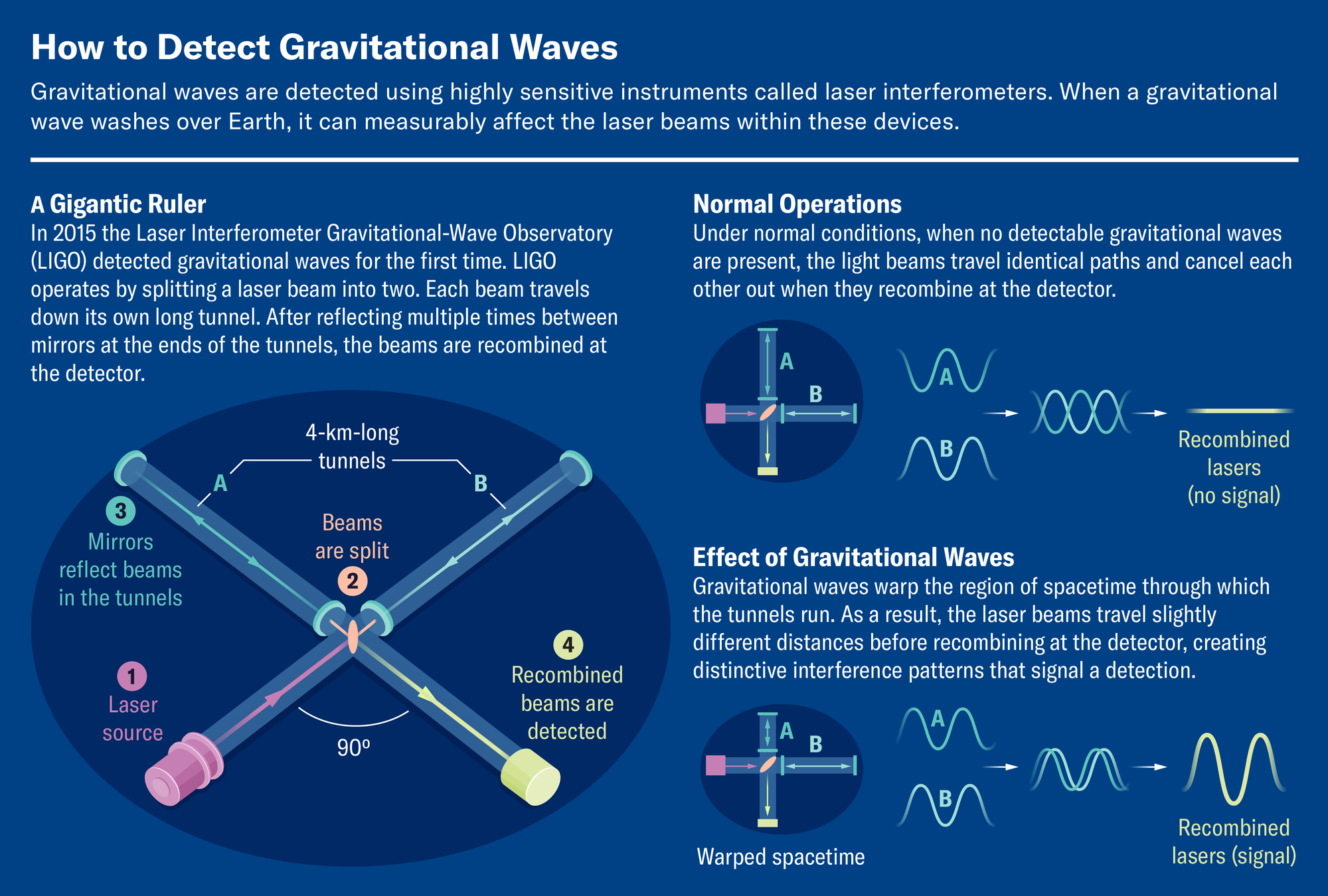
LIGO, Virgo and KAGRA are all large, L-shaped observatories, with each arm of the “L” formed by a kilometers-long vacuum tube insulated against sources of environmental noise such as earthquakes—as well as pounding surf on beaches and passing trucks on highways in their geographic vicinity. Laser beams traversing each arm and bouncing between mirrors at the ends are combined together to reveal extremely slight differences in their travel times, which can be produced when spacetime stretches and contracts because of the passage of a gravitational wave.
Expanding the catalog by finding significantly weaker gravitational waves from farther-off or less energetic sources may be beyond even the capabilities of a fully optimized LVK network. Picking up new melodies in this celestial symphony—such as gravitational waves from merging supermassive black holes, or the cosmic background of primordial gravitational waves produced shortly after the big bang—likely requires building bigger, better “ears.”
“If you want to see smaller signals, you would need, first of all, a much more sophisticated experiment that has a very low noise,” says Arushi Bodas, who theorizes about primordial gravitational waves as a doctoral physics student at the University of Maryland. “Some people are envisioning bigger versions of LIGO, essentially…, or there is an idea of putting [an observatory] actually in space.”
Such larger-scale observatories are likely still many years in the future, researchers say. In the meantime, they hope to piece together more of gravitational waves’ puzzles with deeper analysis of the existing data—and soon with data from the next observation period, set to start later this year.
“It’s really like a detective’s work, where you look for all of the clues that you can and try to see if they point one way rather than the other,” Vitale says. “There will be progress. It probably will be slower than people imagined 10 years ago, but that’s good. It means there is work to do.”

