

NASA’s Artemis II mission nears its historic lunar flyby
The fifth day in space for Artemis II saw space suit tests, an Easter egg hunt and final preparations for an imminent close encounter with the moon
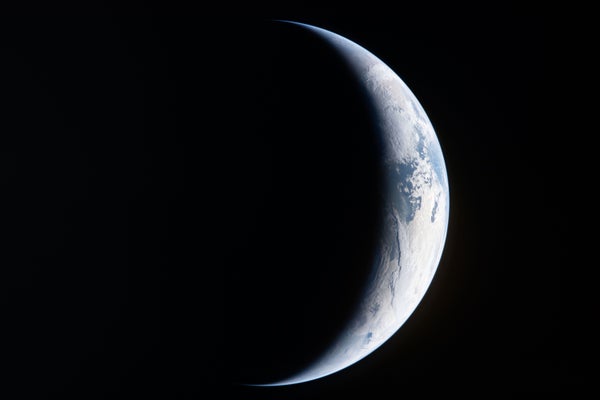
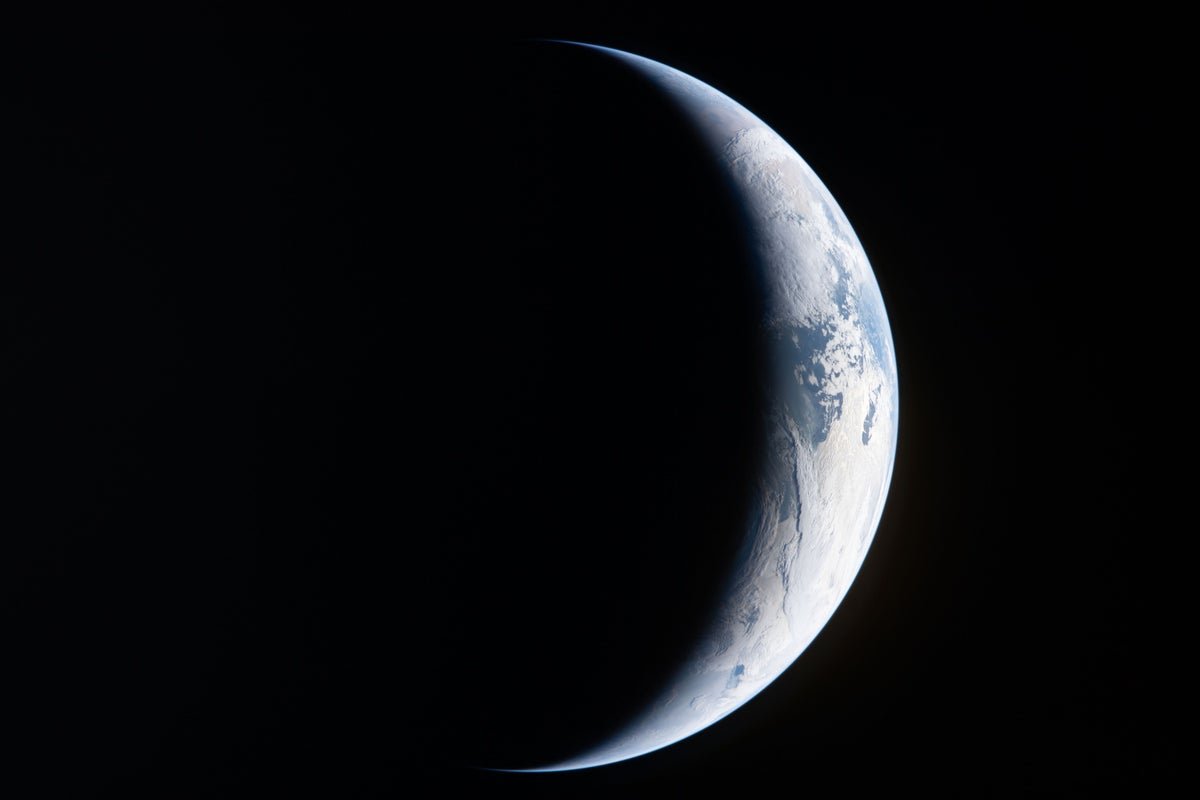
Earth’s sunlit crescent gleams against the blackness of space in this photograph taken by an Artemis II crew member during the mission’s outbound voyage to the moon.
NASA has launched four astronauts on a pioneering journey around the moon—the Artemis II mission. Follow our coverage here.
As Easter Sunday unfolded on Earth, the four crew members of NASA’s Artemis II mission woke up to day five of their sojourn in space with a snippet from CeeLo Green’s “Working Class Heroes (Work).” They also received a recorded message from Apollo 16 moon walker Charlie Duke, who, in 1972, left a personal memento on the lunar surface, where it remains today.
“Below you on the moon is a photo of my family,” Duke said. “I pray it reminds you that we in America and all of the world are cheering you on. Thanks to you and the whole team on the ground for building on our Apollo legacy with Artemis. Godspeed, and safe travels home.”
After the wake-up call (and an impromptu Easter egg hunt for caches of dehydrated scrambled eggs stashed around the cabin), the crew—Reid Wiseman, Christina Koch, Jeremy Hansen and Victor Glover—got to work.
On supporting science journalism
If you’re enjoying this article, consider supporting our award-winning journalism by subscribing. By purchasing a subscription you are helping to ensure the future of impactful stories about the discoveries and ideas shaping our world today.
Day five’s highlights included a test of the Orion crew survival system (OCSS)—better known as the crew’s bright-orange space suits. The suits were designed to protect the astronauts during launch and splashdown, but they can also serve as lifeboats of sorts: if Orion were to depressurize in space, the suits would be able to provide up to six days of air. Two of the astronauts—Wiseman and Glover—attempted to quickly don and pressurize the suits as if they were in an emergency and then practiced climbing into their seats while wearing the garb. They also tested eating and drinking through a small port on each suit’s helmet.
Another key event on day five was an outbound trajectory correction burn—a brief firing of Orion’s auxiliary thrusters at 11:03 P.M. EDT to keep the spacecraft on track for the journey to the moon and the return trip.
Early Monday morning at 12:41 A.M., the spacecraft entered the lunar sphere of influence—where the moon’s gravitational pull exceeds that of Earth’s. Day six brings their long-awaited rendezvous with the moon: an approximately six-hour lunar observation period beginning at 2:45 P.M. Over the course of several hours, the crew will see and study the moon from as close as 4,070 miles from its surface, witnessing parts of the far side for the first time with human eyes, targeting about 35 lunar sites for lunar observation and snapping thousands of photographs. At 8:35 P.M., near the encounter’s end, the astronauts will also see a solar eclipse from space—a rare opportunity to glimpse our star’s corona as well as possible flashes of micrometeoroid impacts on the lunar surface below. And at 1:56 P.M. Artemis II is expected to surpass the distance record set in 1970 by Apollo 13; the crew will reach their maximum distance from Earth—252,760 miles—at 7:07 P.M. This will mark the farthest any humans have ever traveled from our planet.
As of 9:30 A.M. on Monday, Artemis II was more than 228,000 miles from Earth, about 46,000 miles from the moon and traveling at around 1,426 miles per hour.
The farther the crew gets from Earth, the more meditative they have become about all that awaits them back home. The mission has already beamed back spectacular images of Earth from deep space, but the best is yet to come.
“You are humbled,” said Canadian Space Agency astronaut and mission specialist Hansen during an interview with NBC News on Saturday. “The fact that four of us get to be out here just brings you to your knees…. There’s a lot of gratitude for the teams of people that made this possible.”
“Seeing [the moon] in a different way and just pairing that with how much we miss and love our families and knowing that they’re looking up and seeing the same moon, it’s a pretty amazing feeling,” said NASA astronaut and mission specialist Christina Koch during the same interview.
That feeling was especially poignant for mission commander Reid Wiseman, a NASA astronaut and widower who, shortly before the NBC News interview, had spoken with his two teenage daughters—his first chance to speak with them since launch. “It was surreal,” he told NBC News. “For a moment, I was reunited with my little family. It was just the greatest moment of my entire life.”
The crew’s emotions on the eve of Easter Sunday had echoed those of their predecessors on Apollo 8, who had read from the biblical book of Genesis while orbiting the moon on Christmas Eve in 1968. Speaking to CBS News in the closing hours of day four, NASA’s Victor Glover, pilot of Artemis II, used the moment to offer a heartfelt message of unity: Earth, our shared oasis in the void, is what has made their mission special—not the other way around.
“You guys are talking to us because we’re in a spaceship really far from Earth, but you’re on a spaceship called Earth that was created to give us a place to live in the universe,” he said. “Maybe the distance we are from you makes you think what we’re doing is special. But we’re the same distance from you, and I’m trying to tell you, just trust me, you are special…. As we go into Easter Sunday thinking about, you know, all the cultures all around the world—whether you celebrate it or not, whether you believe in God or not—this is an opportunity for us to remember where we are, who we are and that we are the same thing and that we’ve got to get through this together.”
Huddled close in Orion, the four astronauts reached out to clasp hands as Glover finished speaking. The apex of their time together in space—the lunar flyby of day six—has almost arrived.
It’s Time to Stand Up for Science
If you enjoyed this article, I’d like to ask for your support. Scientific American has served as an advocate for science and industry for 180 years, and right now may be the most critical moment in that two-century history.
I’ve been a Scientific American subscriber since I was 12 years old, and it helped shape the way I look at the world. SciAm always educates and delights me, and inspires a sense of awe for our vast, beautiful universe. I hope it does that for you, too.
If you subscribe to Scientific American, you help ensure that our coverage is centered on meaningful research and discovery; that we have the resources to report on the decisions that threaten labs across the U.S.; and that we support both budding and working scientists at a time when the value of science itself too often goes unrecognized.
In return, you get essential news, captivating podcasts, brilliant infographics, can’t-miss newsletters, must-watch videos, challenging games, and the science world’s best writing and reporting. You can even gift someone a subscription.
There has never been a more important time for us to stand up and show why science matters. I hope you’ll support us in that mission.


