
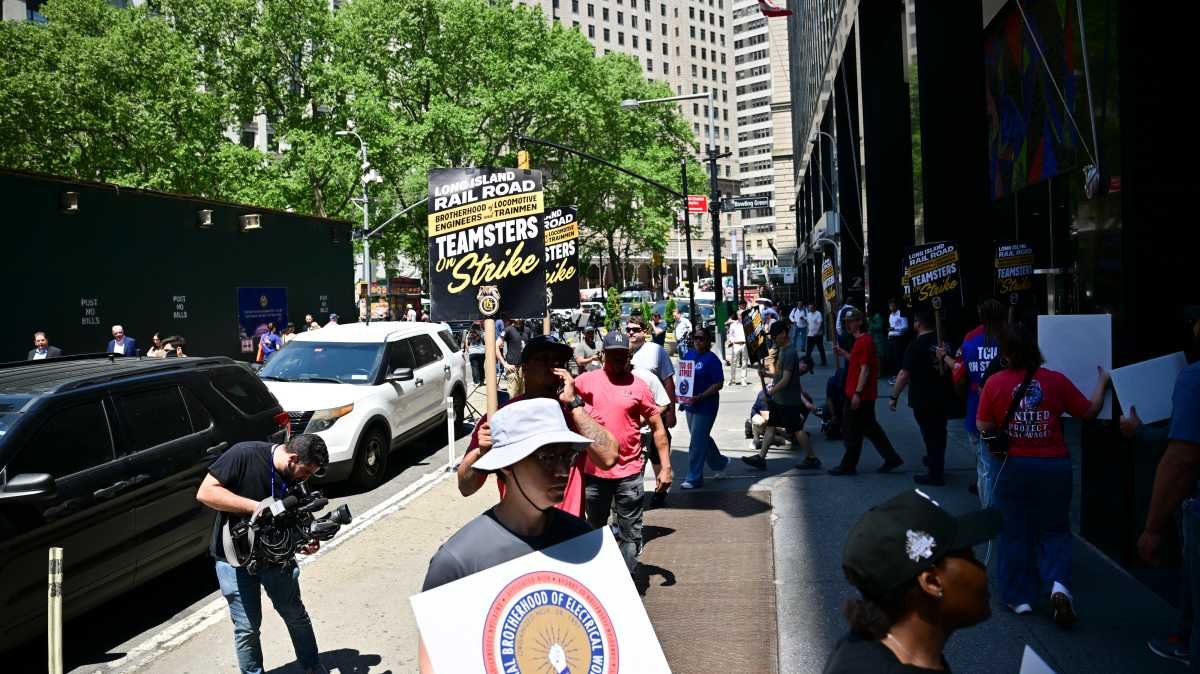

A strike that ground the Long Island Rail Road, the nation’s busiest commuter rail system, to a halt for the past three days ended Monday night as the MTA and representatives of five unions representing half of the system’s workforce came to an agreement, Gov. Kathy Hochul announced.
Train service is expected to return Tuesday afternoon, with phased-in service beginning at about noon, the governor said.
The agreement, the details of which officials refused to disclose, came after a weekend and a Monday when the LIRR’s nearly 300,000 daily commuters were left scrambling to find alternative ways to get between Long Island and the five boroughs. As the 3,500 striking workers took to picket lines across the city and Long Island to demand higher raises, LIRR commuters had to take shuttle buses, the subway, or drive in order to get back and forth.
The workers walked off the job early Saturday morning after the two sides were unable to reach a deal through days of closed-door negotiations.
During a Monday night news conference outside the MTA’s Lower Manhattan headquarters, Hochul said they reached a deal that met the two principles: protecting affordability for riders and giving “fair wages” to LIRR workers.
“This contract will ensure that 3,500 LIRR employees will be paid fairly for their labor,” Hochul said. “We stood firm for a deal that would not require any additional fair increases or tax increases. Period. Full stop. Got it done.”
MTA Chair and CEO Janno Lieber thanked the LIRR riders who “endured a few days of uncertainty and a lot of inconvenience.”
“We are so proud to be able to resume our core mission, which is to serve those three million Long Islanders wherever they need to go,” he added.
Kevin Sexton, vice president of the Brotherhood of Locomotive Engineers and Trainmen (BLET), said the unions are looking forward to their members getting back to work.
Lieber, Hochul, and Sexton all emphasized how difficult the bargaining sessions were after it seemed like riders would be facing another day without the LIRR on Tuesday. Talks continued throughout the weekend and into Monday, with both sides saying they were still far away from a deal late Monday afternoon.
When will the LIRR trains start running again?
LIRR President Rob Free said trains will start rolling once again on the LIRR’s four electric-powered lines at noon tomorrow: the Port Washington, Huntington, Ronkonkoma, and Babylon Branches. He said full service will return at 4 p.m. for the afternoon peak across all LIRR branches, including its diesel lines.
“We have talked to the labor organizations, and we will both do everything we can, you have our word, to get service back up and running with the great on-time performance we run and the reliability and safety that we provide every single day,” he said.
Free added that the contingency bus service will still be provided in the morning.
When asked for the finer points of the agreement, Hochul said they were “not at liberty to disclose all the details” because they still had to be ratified by the unions’ members and approved at the next MTA board meeting, scheduled for Wednesday.
“The trains will be running, we’re not gonna be raising taxes to cover the cost of an increase for the workers, and we’re not going to raise fares to make accommodations either,” Hochul said. “Those were our objectives; we achieved them.”
Although the bulk of contract talks took place over the last couple of weeks, the MTA and the unions have been negotiating over the past couple of years. The process involved two Trump administration-appointed boards weighing in with recommendations for how to achieve a deal.
The main sticking point throughout the negotiations was the size of raises for the five unions. While the two sides agreed on a 9.5% retroactive raise for the first three years of the contract — 2023 through last year, they were at odds over how much wages should go up this year.
At first, the unions wanted a 6.5% bump for 2026, while the MTA was only offering 3%. Over the past week, the unions brought their ask down to 5% and then to between 4% and 5%.
A couple of weeks before the strike, the MTA offered a 4.5% raise, but only if the unions agreed to change work rules that currently allow them to rack up overtime. The unions made clear they would not agree to a “concessionary” deal that included those tweaks and they were taken off the table.
The MTA then offered the unions a 3% raise for this year, plus a lump sum payment that would have equated to a 4.5% increase, but would not have carried over to future years. They said that was necessary to avoid a relatively small portion of the MTA workforce setting the bargaining pattern for its other unions — particularly TWU Local 100, which represents nearly 40,000 transit workers.
The unions also publicly bashed the lump-sum proposal, calling it a “gimmick.”

