

Gas prices are spiking. So why aren’t U.S. oil companies drilling more?
As the U.S. and Iran fight for dominance in the Strait of Hormuz, U.S. gas prices are continuing to rise—and production might not keep up
Tetra Images/Getty Images
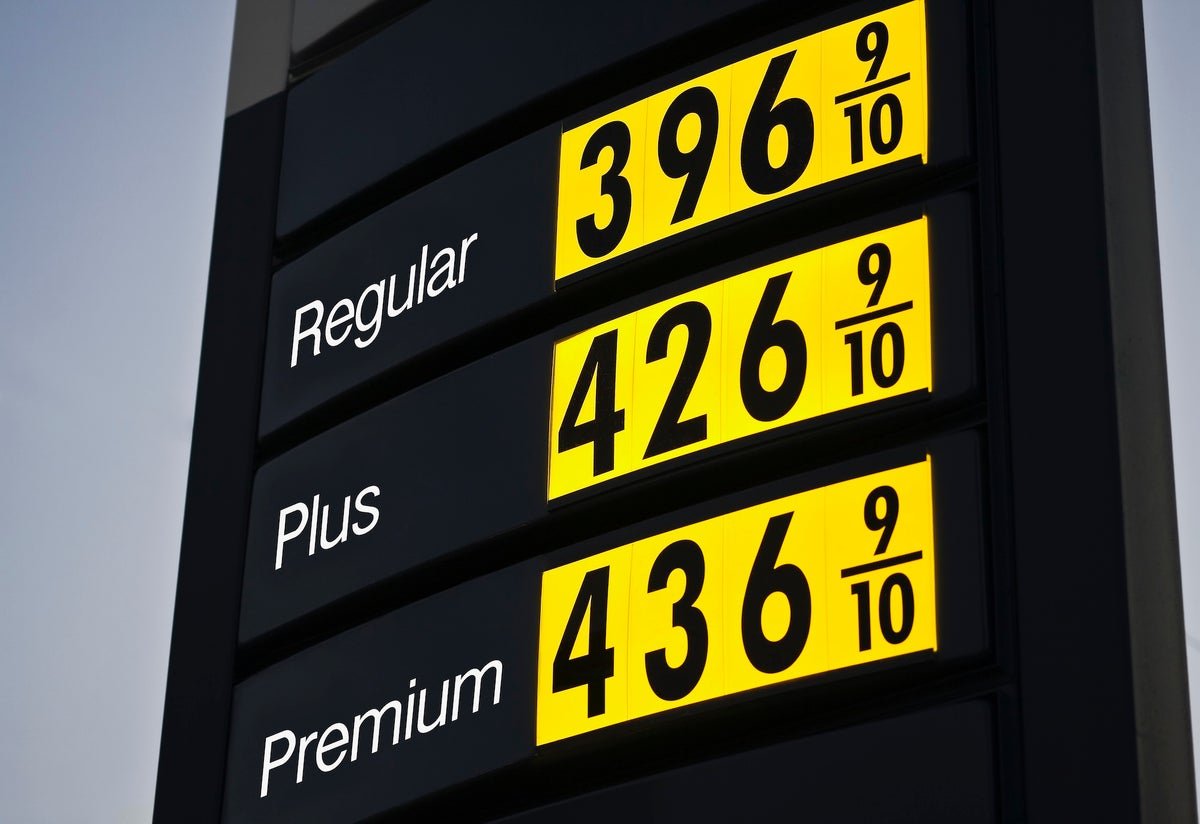
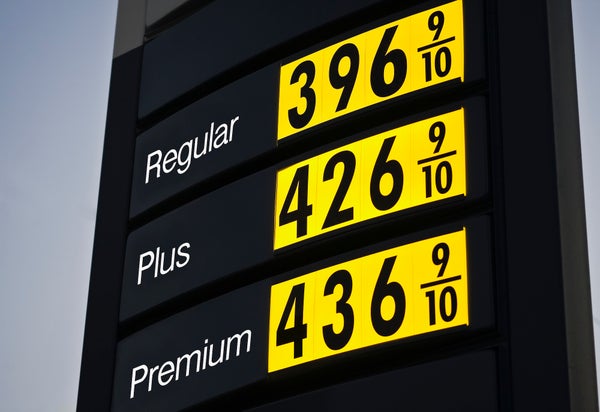
The closure of the Strait of Hormuz has trapped one fifth of the world’s oil supply in the Persian Gulf, a crisis that the World Bank Group predicts will spike energy prices by 24 percent in 2026—the biggest increase since Russia invaded Ukraine in 2022. And the U.S. is not immune. Despite being a major producer of oil and gas, domestic production won’t help curb rising prices at the pump—currently around $4.50 per gallon nationally—any time soon.
Spikes in oil and gas prices are causing headaches for consumers fueling up their cars or paying for more expensive deliveries, but U.S. oil and gas companies are seeing windfall profits. That might seem like an incentive to drill more, but lessons learned from previous oil gluts and geological hurdles to drilling more—not to mention ongoing uncertainty—tell a more complicated story.
“This volatility just really messes with people,” says Trey Cowan, an energy finance analyst at the energy market analysis firm Institute for Energy Economics and Financial Analysis.
On supporting science journalism
If you’re enjoying this article, consider supporting our award-winning journalism by subscribing. By purchasing a subscription you are helping to ensure the future of impactful stories about the discoveries and ideas shaping our world today.
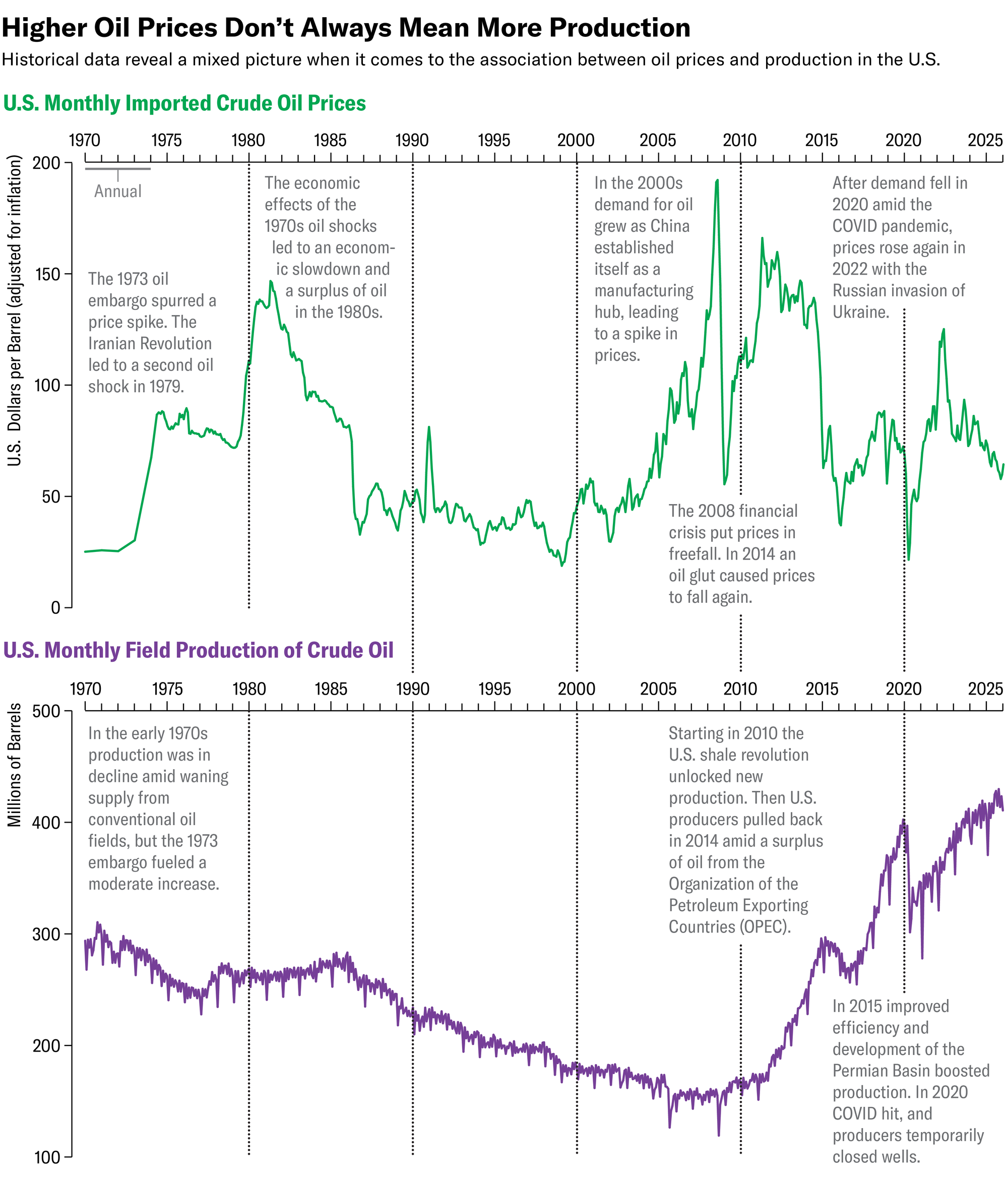
Oil and gas go through repeated boom-bust cycles. Price is one driver of how much domestic producers drill, but it’s not the only one: Historically, technology has played an even larger role in how much oil is pulled from the ground. For example, the global average price of oil per barrel spiked nearly 300 percent by 1974 because of the 1973 oil embargo, in which the Organization of Arab Petroleum Exporting Countries (OAPEC) banned exports to nations that supported Israel in that year’s Yom Kippur War. U.S. producers amped up activity, but production never surpassed the peak hit in 1970, and drilling technology then couldn’t access the hard-to-reach deposits that were left. In the late 1990s and early 2000s crude oil prices rose alongside those of other commodities. But U.S. domestic production continued to slide until new drilling technology unlocked a boom in shale oil production by the 2010s.
Amanda Montañez; Source: U.S. Energy Information Administration (data)
Deposits that were previously too difficult to reach could be exploited because producers could now drill horizontally through rock layers and then stimulate the flow of oil by hydraulic fracking. But the “shale revolution” showed how fickle oil prices can be. The Organization of the Petroleum Exporting Countries (OPEC) declined to cut production in response to the new U.S. glut of oil, triggering a 70 percent plunge in prices between 2014 and 2016. Investors burned by that bust are still leery of pouring money into oil and gas a decade later, says Brandon Davis, founder of AFE Leaks, a consulting firm that tracks capital costs for oil and gas. Labor and materials are also more expensive now because of inflation, Cowan says.
Long-term, expect no great surge in new U.S. drilling. “Oil companies don’t usually respond to economic conditions brought on by policies that can be temporary,” says Patrick De Haan, head of petroleum analysis at GasBuddy, an app that tracks gas prices for drivers. It takes six months or more to get full production from a new well, Cowan says, so producers making these decisions must think about what the fuel will cost months down the line. Oil futures markets currently project that, by October, West Texas Intermediate crude will cost less than $90 per barrel, compared with more than $105 per barrel today. But the World Bank and Barclays have increased their gas price forecasts for the rest of the year. “The longer this goes on, the worse it’s going to get,” says Davis, who think the markets are overly optimistic that the Strait will soon reopen. He believes that prices should be even higher than they currently are.
Increasing production won’t make up for the current shortfall, either. Much of the country’s shale production has been tapped, leaving less productive and less economic deposits. The totality of U.S. production is about 13.6 million barrels of oil per day, compared with the 20 million barrels per day that are trapped by the Iran war.
So far, large firms such as ExxonMobil and Chevron are still holding to their drilling plans from before the U.S.-Iran war, according to recent statements by executives. Smaller privately owned producers, however, are beginning to weigh expedited drilling, Davis says. For example, Oklahoma City–based Continental Resources announced in April that it will be adding rigs. And on Monday Diamondback Energy, which operates in Texas and New Mexico, pledged to pump 3 percent more oil than had been previously planned this year.
There is one major difference to past price spikes: cheap renewable energy is an available alternative that wasn’t so accessible in the past. Wind and solar generated 17 percent of U.S. electricity in 2025, according to the U.S. Energy Information Administration, a government agency that tracks energy statistics. That base level of renewables is reducing demand for fossil fuels in the utilities sector. “The renewables are saving our bacon for how quickly the energy prices are rising,” Cowan says.
But the relief is limited. Americans are spending roughly half a billion dollars more a day on fuel than they would likely have spent if the Iran conflict hadn’t happened, De Haan says. “At the end of the day,” he says, “it’s simple economics. Prices are going up because there has been a drastic reduction in supply.”
Disclosure: The reporter’s spouse is employed in the oil and gas industry and owns interests in wells.
It’s Time to Stand Up for Science
If you enjoyed this article, I’d like to ask for your support. Scientific American has served as an advocate for science and industry for 180 years, and right now may be the most critical moment in that two-century history.
I’ve been a Scientific American subscriber since I was 12 years old, and it helped shape the way I look at the world. SciAm always educates and delights me, and inspires a sense of awe for our vast, beautiful universe. I hope it does that for you, too.
If you subscribe to Scientific American, you help ensure that our coverage is centered on meaningful research and discovery; that we have the resources to report on the decisions that threaten labs across the U.S.; and that we support both budding and working scientists at a time when the value of science itself too often goes unrecognized.
In return, you get essential news, captivating podcasts, brilliant infographics, can’t-miss newsletters, must-watch videos, challenging games, and the science world’s best writing and reporting. You can even gift someone a subscription.
There has never been a more important time for us to stand up and show why science matters. I hope you’ll support us in that mission.

