
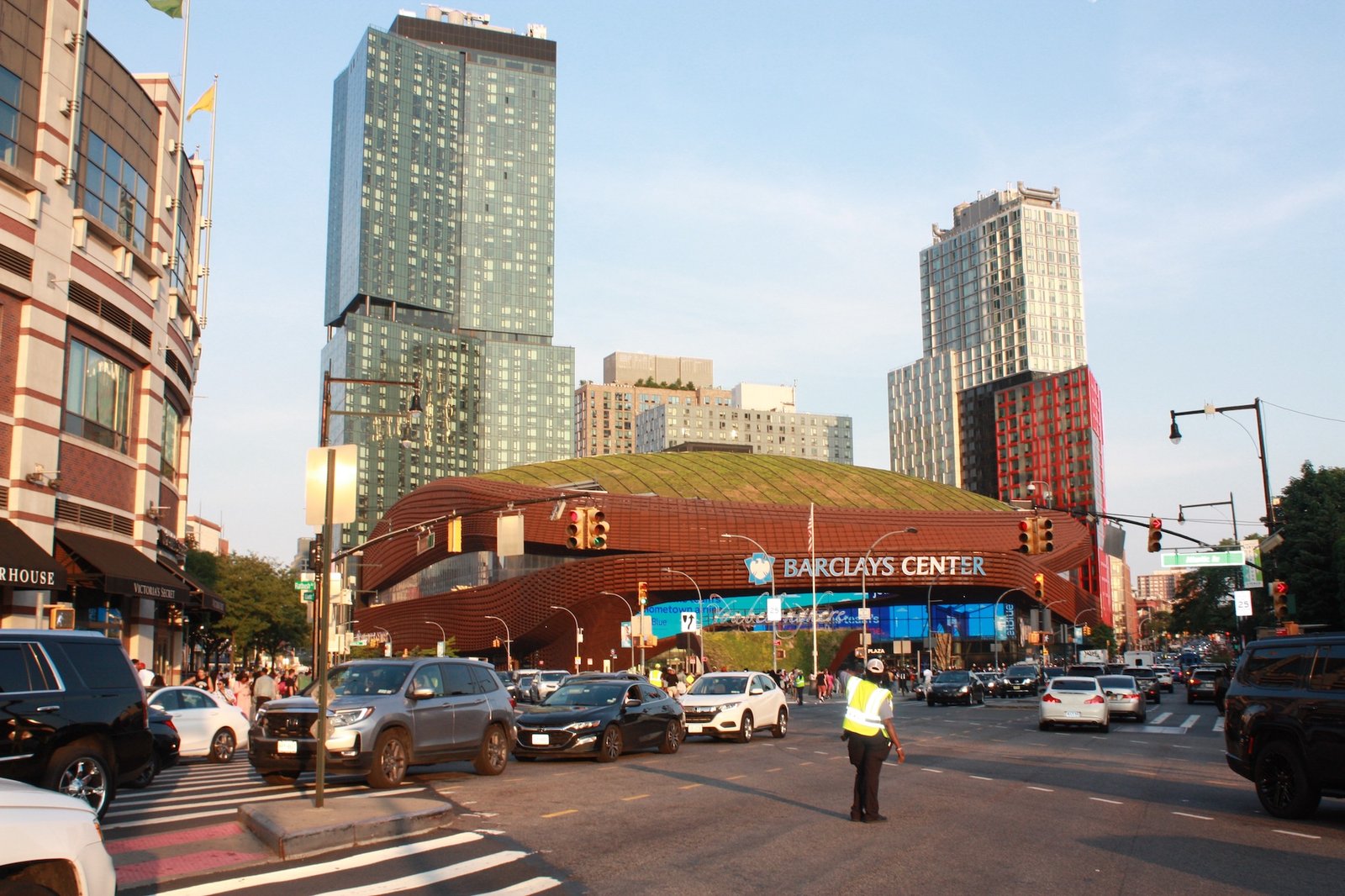
Brooklyn’s long-stalled Pacific Park megadevelopment inched closer to the finish line this week as developers unveiled a $5 billion plan to complete the project. Empire State Development, Cirrus Workforce Housing, and LCOR released a plan on Monday for the second phase of the project, formerly called Atlantic Yards, calling for seven new towers with 5,600 housing units, including roughly 1,242 affordable homes for low- and moderate-income households. The plan marks the start of the final chapter of the delayed megaproject, which saw its future thrown into doubt after a foreclosure and a change in developers last October.
First proposed in 2003 as Atlantic Yards and initially led by developer Forest City Ratner, the 22-acre project originally called for a new arena for the former New Jersey Nets and 15 residential and office buildings, anchored by a glass supertall tower designed by Frank Gehry, as 6sqft previously reported.
The development included a platform planned above the MTA’s Atlantic Yards rail yard at the intersection of Pacific Street and Atlantic, Carlton, and Vanderbilt avenues. The state deemed the rail yard a “blight,” a major factor in its decision to acquire the sites through eminent domain and lease them to developers.
Lawsuits from residents and property owners displaced under the eminent domain agreement delayed construction for years. A planned modular tower that ran into obstacles further stalled the project, along with major crises such as the 2008 financial crash and the COVID-19 pandemic.
The expiration of the 421-a property tax abatement in 2022 also created another setback, with Greenland USA, an early stakeholder that took over more than 95 percent ownership of the project in 2018, saying that without it, it could not construct the affordable units.
A 2014 agreement with the city required Greenland to build 876 additional affordable units by 2025. The deal imposed a $2,000-per-month penalty for each unbuilt unit, which could total up to $21 million annually if deadlines were missed.
By December 2023, developers had completed nine of the 15 planned buildings and scrapped plans for the Gehry-designed tower. The Barclays Center, owned by Mikhail Prokhorov and home to the Brooklyn Nets, had already opened.
That month, Greenland USA defaulted on nearly $350 million in loans tied to the second phase, sending the project to a foreclosure auction and passing on the penalties and affordable housing requirements to the new developer.
Last October, Cirrus Real Estate and LCOR acquired the development rights to Pacific Park, contributing $12 million to an affordable housing fund to offset penalties that were not enforced against Greenland USA for failing to build the 876 affordable units.
Greenland is staying on as a partner, though in a much smaller capacity. The firm plans to monetize the B1 parcel, where a tower was previously planned, and Site 5 across Flatbush Avenue, as 6sqft previously reported. This would allow for a two-tower project at Site 5, which ESD has already approved, though it still requires public approval and a vote by the ESD board, according to the Atlantic Yards Report.
The new development team returned to ESD on Monday with a revised approach to finish Pacific Park, nine months later.
The proposal would be carried out by a design team that includes Kohn Pedersen Fox as master plan architect, Michael Van Valkenburgh Associates as master plan landscape architect, Of Place, leading placemaking and the public realm, and WSP spearheading structural work and serving as MEP engineer.
To build platforms over the railyards—one of the project’s most complex and costly components—the developers intend to use some of the foundations laid years ago. The state has also included $175 million in subsidies for the project in its budget, according to the New York Times.
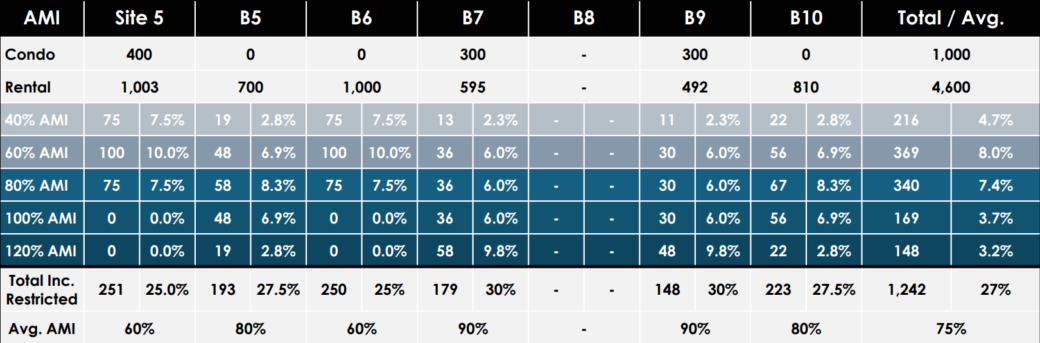
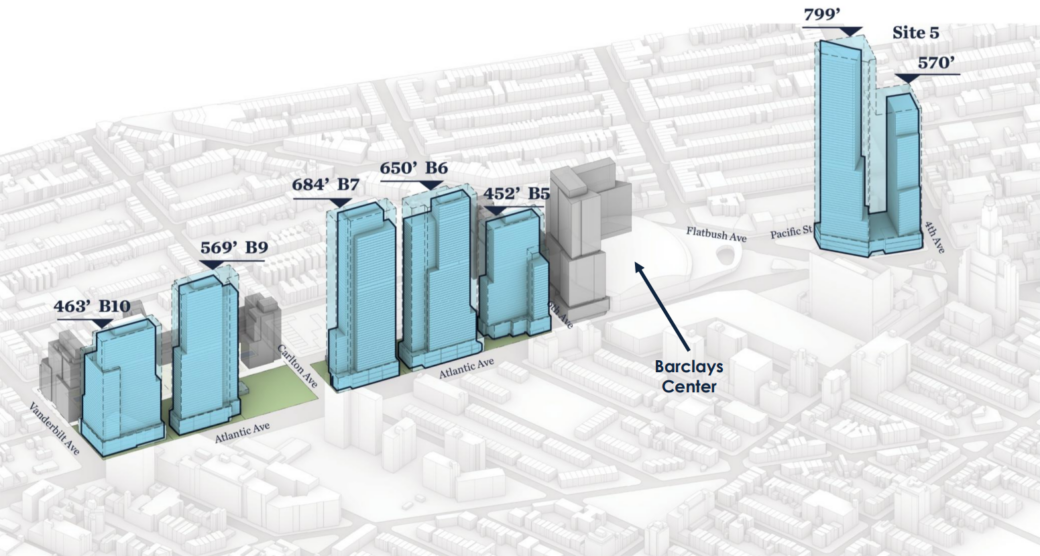
The plan calls for seven new buildings on six sites (including a two-tower building on site 5), with 4,600 rentals and 1,000 condos. Compared with the previous plan, the development will add 2,382 additional units to the original plan, for 8,812 total apartments.
The tallest tower would be 799 feet on site 5, currently home to a P.C. Richard store and former Modell’s. The remaining buildings range in height between 452 feet and 684 feet.
According to Monday’s presentation, there is strong demand for low- and moderate-income and family-sized rental units.
Phase two of the plan includes 1,242 income-restricted units for low- and moderate-income households, with over 30 percent designated as family-sized. That marks about 30 percent affordable apartments, compared to the 35 percent approved 20 years ago.
One of the first buildings to rise, just south of Flatbush Avenue between Atlantic Avenue and Pacific Street, would deliver 1,430 units.
Based on early estimates and this year’s affordability guidelines, the Times projects that about 50 units in the building would be affordable to families of four earning up to $67,840, and more than 150 apartments would be affordable to households of four earning up to $101,760.
The new proposal also addresses a strong desire for expanded open space. Compared with the currently approved plan, which features smaller, disconnected green spaces throughout the development, the revised plan envisions 8.5 acres of continuous open space designed for active recreation, seating, and gathering.
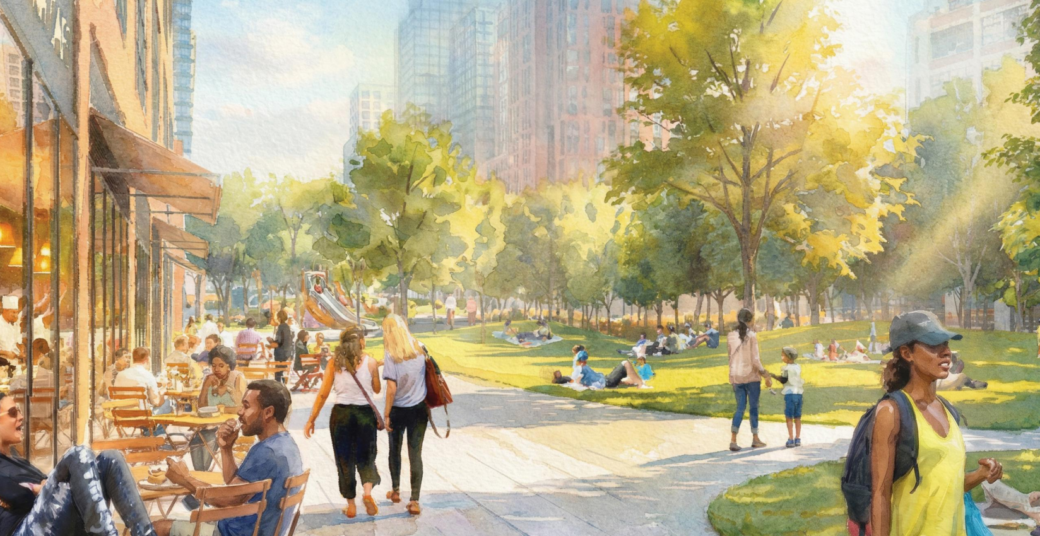
The open space includes B8 Park, with a mix of active and passive programming, exceeding previously approved open space requirements.
Streetscape improvements would create safer intersections, enhance lighting, and widen sidewalks and crosswalks, with a strong emphasis on adding greenery and shade. Improved intersections and lighting would also provide better connectivity to the surrounding area.
Wind mitigation is also a key component of the public realm improvements. In the new plan, the base heights of buildings have been lowered, while base articulation has been increased, helping to mitigate stronger wind conditions created by sheer, straight building forms.
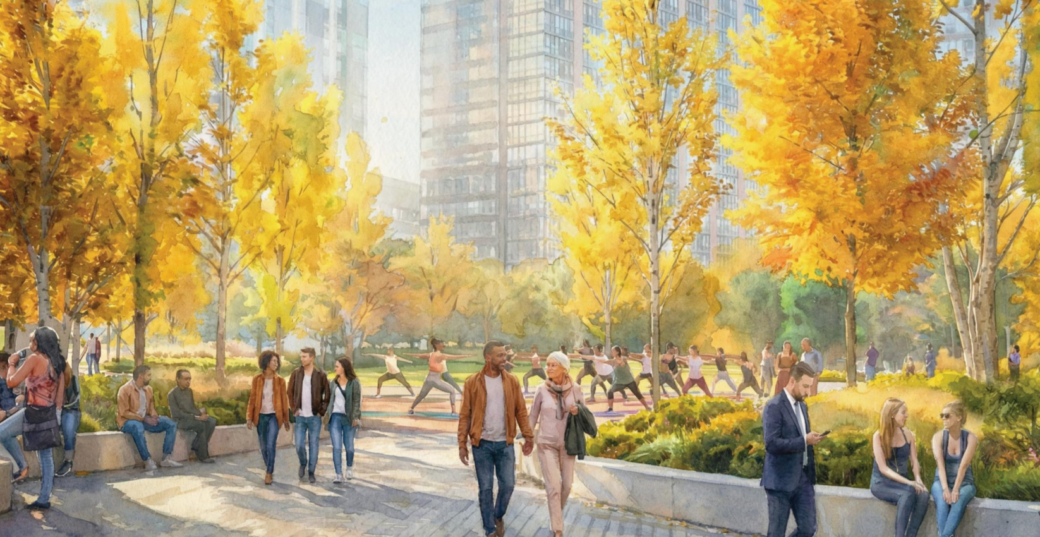
The proposed master plan also prioritizes community space. Several community facilities are planned, including an intergenerational community center in B6, the first residential building to be delivered, a flexible hub in B10, and a potential revised “urban room” concept in B5.
While the revised plan is a step toward realizing the long-delayed megadevelopment, it has not been without criticism from some locals.
In March, a group of elected officials sent a letter to Gov. Kathy Hochul expressing concerns about the affordability of the apartments. BrooklynSpeaks, a coalition of civic groups, has also called for greater transparency and public input in the project, according to the Times.
During Monday’s meeting, Assemblywoman Jo Anne Simon, one of the letter’s signers, said the project’s affordability metrics and focus on moderate-income housing have failed to address the area’s need for low-income homes.
“We do know that the crying need for housing in this city is mostly at the lower end. It’s not as remunerative to build that, that’s why we keep being dug into this hole,” Simon said. “I think we need to have more conversations that are more interactive with the community. The people who went to those meetings were the people who live in the area, it’s already been gentrified.”
“We’ve already lost 25 percent of the African American population from those community boards,” she added. “It’s a snapshot. It’s not really an indicator of community and the people who are here and the need for housing.”
The project is estimated to cost $5 billion. New York will provide $700 million in public funding to build platforms over the railyard needed to build, as Gothamist and the Times reported.
Before work can begin, the plan must undergo an environmental review that state officials say could begin in September. Work could begin as early as 2028.
RELATED:

