
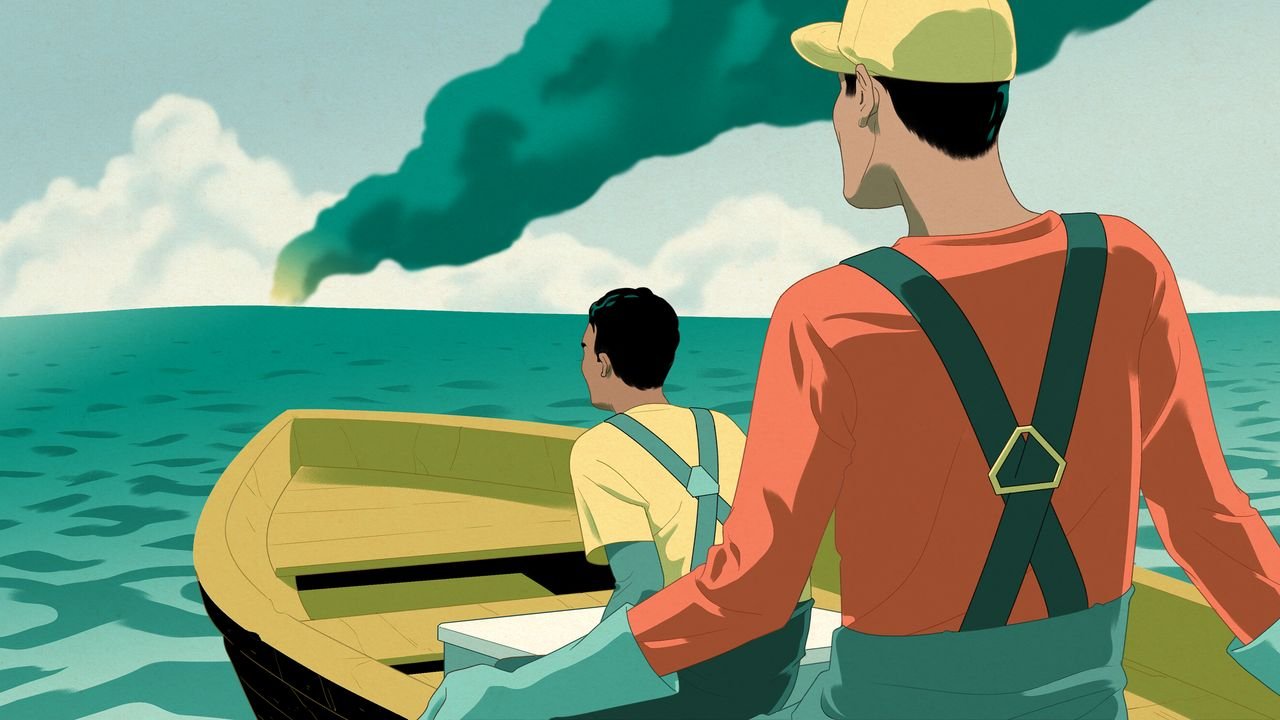
At daybreak on January 20th, four crew members took two skiffs in opposite directions to spread miles of baited hooks along a horizontal cord, planning to haul it back by evening and meet the Fiorella at a rendezvous point. Valencia called his father again. He could still hear the drone and aircraft, he said, but they were quieter than before. “So far, we’re fine,” he told Johnny. Midsentence, the connection dropped. Valencia’s prepaid minutes must have run out, Johnny thought; he and his wife started calling friends to scrape together money to add more.
Flores and Álvarez, on one of the skiffs, were floating approximately fifteen nautical miles east of the Fiorella. Around one o’clock, as they were taking a break, they noticed a column of smoke to the west—“very tall, very black, very large,” according to Flores. They had spoken with Valencia by radio hours earlier; now their calls wouldn’t connect. For another hour, the smoke kept rising.
Eventually, Flores and Álvarez motored to the rendezvous point, where there was no sign of the Fiorella, or of the other skiff. The next day, they shot a cellphone video as they dumped their catch—half a dozen small blue sharks—to lighten the load, realizing that they would have to try to make it back to shore, hundreds of miles away, on what little fuel they had. “The boat just disappeared,” Flores shouts, in the recording. “We’re totally lost here.” The men were soon out of water. On the morning of January 22nd, another boat, Dios Es Mi Guía (God Is My Guide) found them, sunburned and dehydrated.
That evening, the Fiorella’s owners—Eduardo Moreira and Nancy Rivera—reported the boat missing, and the following day they filed a complaint at the public prosecutor’s office, triggering a preliminary investigation. Navy officials in Manta, a larger, neighboring port city, said that a search had been activated, but offered no specifics. The owners, anxious and increasingly desperate, chartered a boat and mounted their own search; after a few days, the crew discovered parts of the Fiorella’s longline gear floating about ninety nautical miles northwest of its last recorded position. The owners informed the Navy and the prosecutor’s office of their find, but, according to Juan Alvia Cevallos, a lawyer representing them and the families of the missing men, no one ever asked to inspect it.
Alvia and the families came to doubt that an official search was under way at all; in fact, it seems that the Navy, according to a later report, waited a full nine days from the initial alert to task another vessel to look for the Fiorella, requesting only that it scan along its existing route, to the Galápagos, nowhere near the Fiorella’s last known coördinates. After about a month, the Navy shifted the search from “active” to “passive”—standard procedure when officials believe the probability of finding survivors is low. The families have insisted that the missing men have no connection to the drug trade, and that they are owed an explanation of what happened. But, according to Alvia, during a visit to Manta’s port authority, a Navy official suggested to the families that the men knew what they got themselves into, and “they had to face the consequences.”
The seafaring province of Manabí—which includes Manta and Jaramijó—has in the past two decades been utterly transformed by the drug trade, and by various attempts to crack down on it. In the early two-thousands, Colombian cocaine traffickers, seeking to evade tightening controls in their country, began to reroute shipments through coastal towns in Manabí and elsewhere in Ecuador. Emissaries of the Sinaloa cartel arrived, too. Expert navigators in places such as Jaramijó were offered large sums of money to move parcels of drugs and later to run fuel to narco-vessels, which would in turn bring the shipments to Central America and Mexico. Networks of enganchadores, or “fixers,” emerged to coerce fishermen who resisted, often by stealing boat motors to push them into debt—and, as a result, into servitude to the traffickers. (In the past two years, at least seven boat captains in the Manta area have been assassinated; Ecuadorian police suspect that the killings were reprisals for resisting the commands of traffickers or tied to disputes between them.)

