
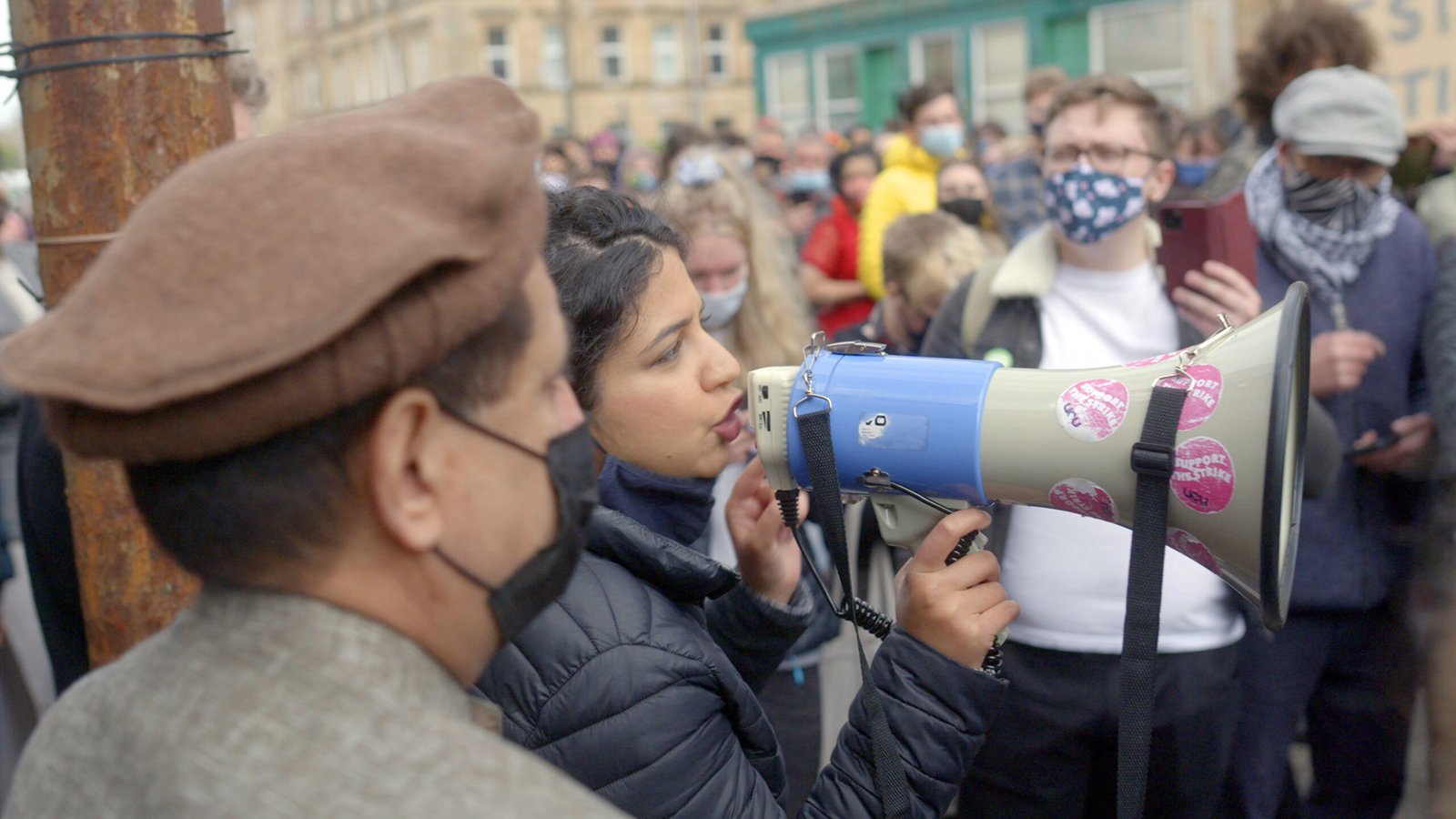
Everybody to Kenmure Street documents a moment when civic instinct overtook fear. In May 2021, on the morning of Eid, a Home Office dawn raid in Glasgow’s Pollokshields neighborhood was interrupted by something the state was not prepared for. Hundreds of residents stepped away from breakfast tables, Zoom meetings and daily routines to position themselves between immigration officers and two men facing deportation. What followed was one of the most spontaneous and effective acts of civil resistance in recent British history, achieved not through leadership or long preparation but through proximity, trust and a refusal to submit to an immigration system designed to operate unseen.
Felipe Bustos Sierra, the directors, constructs the events as lived by those documenting them, letting collective action and historical memory emerge without authorial intrusion. The documentary begins by situating this event within a longer civic memory. Archival footage traces the shaping of modern Glasgow, intercut with moments of political ruptures. Margaret Thatcher dismissed trade unionists as dinosaurs standing in the way of progress, and the Scottish Trades Union Congress responded in kind, marching through the city to chants of “Maggie, out, out”. From the outset, protest is framed not as an aberration but as something woven into the city’s political DNA. The film’s implication is clear but unforced. Kenmure Street did not suddenly discover resistance that morning. It inherited it.
That sense of inheritance deepens as the documentary turns to the street’s entanglement with Britain’s Atlantic slavery economy, a legacy shared by many of Glasgow’s thoroughfares. Scottish merchants once monopolised the trade in slave-grown produce, particularly tobacco, and the wealth that shaped the city was inseparable from enslaved African labour. When slavery was formally abolished in 1833, and compensation paid to slave owners under the 1837 Act, the cost was underwritten by British taxpayers — a government loan only fully repaid in 2015, amounting to an estimated £16.5bn in today’s terms. One resident describes Glasgow as a city of paradox: fiercely anti-racist and politically radical, yet materially built on exploitation. Archival footage of Nelson Mandela praising the city’s sustained campaigns against apartheid sharpens this contradiction. These historical fragments do not function as digressions. They act as a prelude, locating the events on Kenmure Street within an unresolved moral history rather than a single exceptional day.
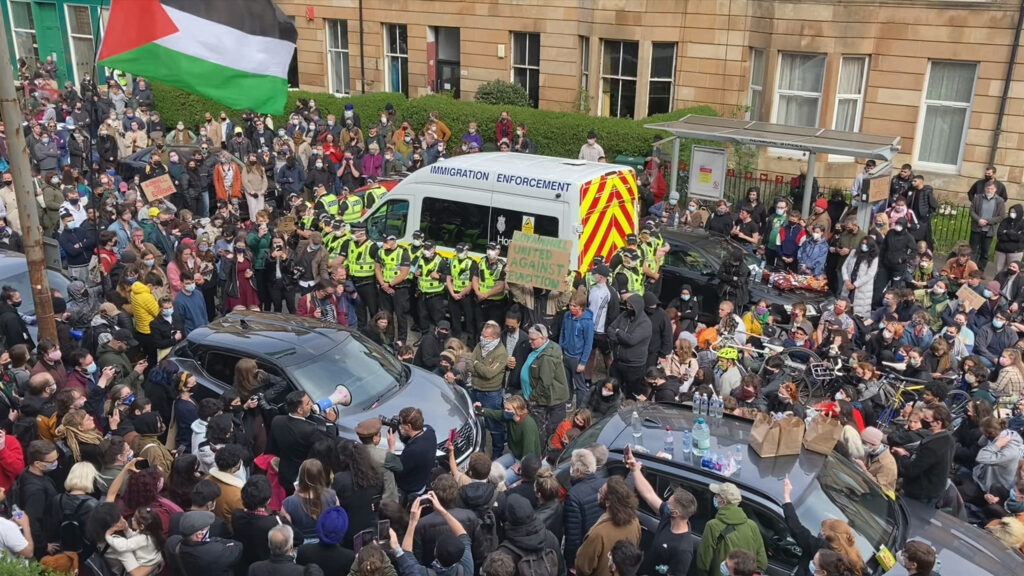
When the film arrives at the stand-off itself, it does so with notable restraint. There is no omniscient narration, no manufactured suspense. Kirstin McMahon’s camera remains close to the street, attentive to faces, gestures, hesitations. The Home Office presence — vans, officers, procedural calm — is filmed without melodrama, which only sharpens the contrast. Authority appears rigid, repetitive, incapable of improvisation. The residents, by contrast, adapt continuously. The sight of people discovering, almost in real time, what collective responsibility might look like. Many of those who gather do not know the detained men personally. What they recognize instead is shared vulnerability, and the intolerable arbitrariness of state power exercised at dawn.
Kenmure Street itself is carefully observed as a lived space rather than a symbolic backdrop. Pollokshields, one of Scotland’s most ethnically diverse neighbourhoods, is shown as a place of long-standing migrant communities, informal networks and everyday solidarity. The resistance that unfolds is not born of ideological alignment but of proximity between neighbours protecting neighbours. The documentary understands that this distinction matters. It is easier to oppose injustice in theory than to interrupt it in practice. Colin Monie’s editing gives the film its internal rhythm, shaping urgency and reflection without ever forcing either. The seamless merging of vertical phone footage, wide-frame images and interviews allows the documentary to move fluidly between immediacy and reflection.
For the most part, Everybody to Kenmure Street resists reconstruction, but it allows itself two carefully judged acts of dramatisation. In one, a woman lies beneath a police van to prevent it from moving, her body rendered as both an obstacle and declaration. In another, the experience of the two men of Indian origin detained inside the van is conveyed through a darkened screen, allowing their voices to carry the fear and claustrophobia of confinement without visual reenactment. These moments are handled with discretion, less as embellishment than as attempts to register what could not be captured at the time. They acknowledge the limits of observational documentary without collapsing into spectacle.
There is an understandable temptation to read the film as a rousing testament to “people power”. It gestures in that direction, but remains wary of uplift. The victory — the men are not deported — feels provisional rather than conclusive. No one pretends the system has been dismantled. It has merely been interrupted. The film’s emotional register is reflective rather than celebratory, tinged with disbelief that such solidarity could surface so quickly — and with the knowledge that it could easily have failed.
The documentary closes on a quietly devastating observation. Immigration policy, for all its bureaucratic language, ultimately communicates something far more intimate. Certain lives are deemed unworthy of belonging. Who, the film asks in its final gesture, gets to make that decision? In an era saturated with images of protest, Everybody to Kenmure Street distinguishes itself through modesty and moral clarity. It does not invite admiration from a safe distance. Instead, it leaves the viewer with a more uncomfortable question. What would we have done if we lived on that street, heard that message, and had to decide whether to leave the table?
Everybody to Kenmure Street is screening in the World Cinema Documentary Competition at this year’s Sundance Film Festival.

Sundance 2026: ‘Everybody to Kenmure Street’ Review – Civic Resistance on a Glasgow Street

