


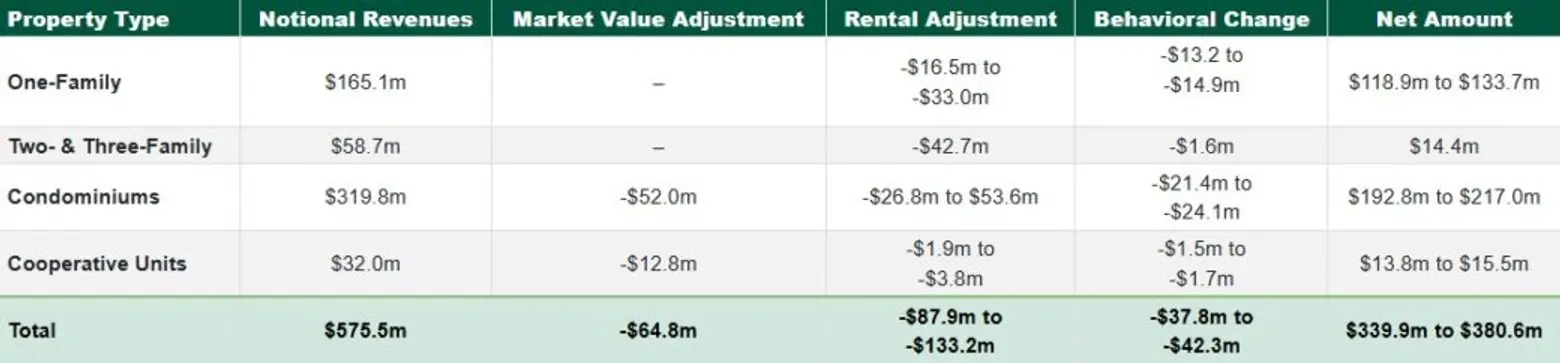
Gov. Kathy Hochul’s proposed pied-à-terre tax could generate up to $500 million annually, but multiple variables could affect the final revenue, according to a report released Thursday by New York City Comptroller Mark Levine. Introduced last month, the governor’s proposed tax, which would place a surcharge on secondary homes in the five boroughs valued at $5 million and above, could generate nearly $500 million from just over 11,200 properties. The comptroller’s analysis examines several factors, including exclusions for rented units and “behavioral responses” to the tax, which could lower the actual revenue to between $340 million and $380 million.
These secondary homes, also known as pieds-à-terre, are typically occupied by part-time residents who stay in the city while working or visiting. Last month, Hochul proposed an annual tax on non-primary residences after resisting calls from progressives, including Mayor Zohran Mamdani, to increase taxes on high-income earners.
In 2017, there were 75,000 pieds-à-terre, according to NYC Housing and Vacancy. The most recent survey by the group, with findings from 2023, found a significant drop off, with 59,000 units, as 6sqft previously reported.
While similar proposals date back to 2014, renewed interest in a pied-à-terre tax comes as the five boroughs face a $5.4 billion budget gap, which has pushed Hochul to revisit the idea. According to the governor, the tax could generate at least $500 million annually in revenue.
Using previous pied-à-terre tax proposals to estimate potential revenue, Levine’s report supports the $500 million projection but notes that several factors could reduce the final total.
First, the taxation of two- and three-family properties, as well as mixed-use buildings, presents challenges due to uncertainty over how to allocate market value between commercial activity and individual units.
Levine gives the example of a $6 million two-family building with one pied-à-terre and one rented unit: if the value were split evenly, the pied-à-terre would fall below the $5 million threshold and be exempt from taxation.
He notes that this approach would also exempt most two-family properties in the first two tax brackets and three-family properties in the first three brackets. As a result, fewer than 200 two-family buildings and about 30 three-family buildings would remain subject to taxation.
Levine recommends that the Department of Finance (DOF) establish a new valuation method based on square footage, or alternatively, allow owners to submit separate appraisals for the pied-à-terre portion of a building.
Next, market value adjustments for condominiums and cooperatives could lower revenue. The city’s DOF currently assesses condos and co-ops based on the “hypothetical” income they would generate if they were rental buildings, making assessed values a poor reflection of true market value.
As a result, many units that appear taxable would actually fall below the threshold, reducing the number of eligible properties from 19,107 to 11,226.
In addition, some luxury condos are not occupied by their owners and are instead rented out full-time to tenants. As a result, these units are not technically vacant second homes, meaning many properties could be excluded from taxation.
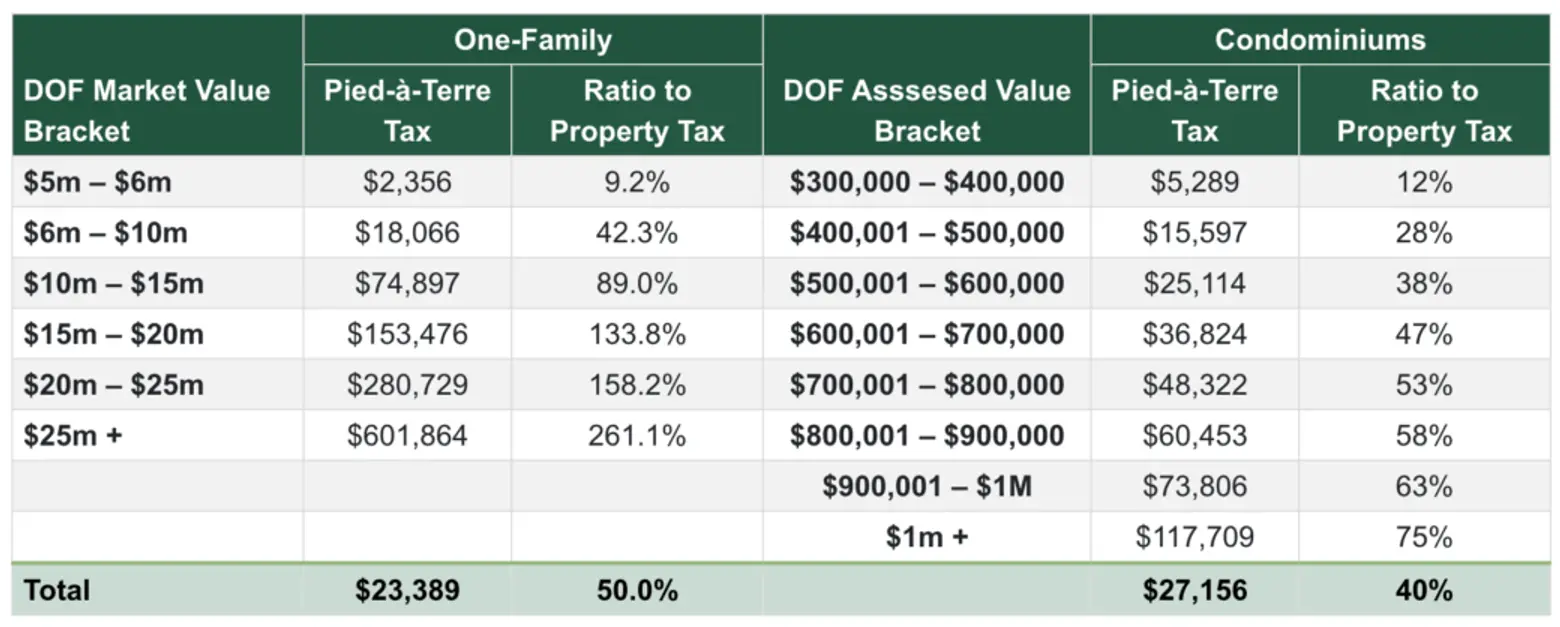
The report says revenue could decline as property owners change behavior in response to the tax. To generate the $500 million as intended, the tax increases would need to be significant, according to the report. Annual tax bills for owners of condos, according to Table 7 above, could increase between $5,289 and $117,709.
Levine points to Vancouver, Canada’s 2017 Empty Homes Tax, which imposes a surcharge on residential properties left vacant for more than six months per year.
Since its implementation, Vancouver has seen a sharp drop in vacant units, with the number falling by more than 60 percent between 2017 and 2024. A 2024 study cited in the report found the tax alone led to a roughly 21 percent reduction in vacant homes.
While the exact impact on behavior in NYC is uncertain, Levine wrote that it is “unreasonable to assume there will be none.” He estimates behavioral changes could reduce expected revenue by about 10 percent in the first two years after enactment, with losses potentially compounding over time.
In the report, Levine concludes he supports including the proposed tax in the city’s financial plan, but with a “prudent revenue assumption.” He also recommends that the DOF and Office of Management and Budget publish the assumptions on rental shares, market value cutoffs, and ownership treatment.
He said a “transparent baseline” would make it possible to monitor early revenue collections against expectations and adjust the city’s budgeting and auditing practices as experience with the tax grows.
Following the report’s release, James Whelan, president of the Real Estate Board of New York, a real estate lobbying group that has opposed the tax, said:
“Comptroller Levine’s analysis is yet another confirmation that a tax on second homes would not deliver the tax revenue expected.”
“This proposed tax also presents significant logistical issues as to how you identify second homes, value co-ops and condos, and account for changes in taxpayer behavior. If implemented haphazardly, this tax would result in less investment, less housing and less revenue for the City, State and MTA.”
Dora Pekec, a senior spokesperson for the Mamdani administration, told CBS News that the mayor is confident the tax will generate $500 million annually.
“The comptroller’s report makes one thing very clear: thoughtfully crafting and implementing this legislation will do exactly that.”

