
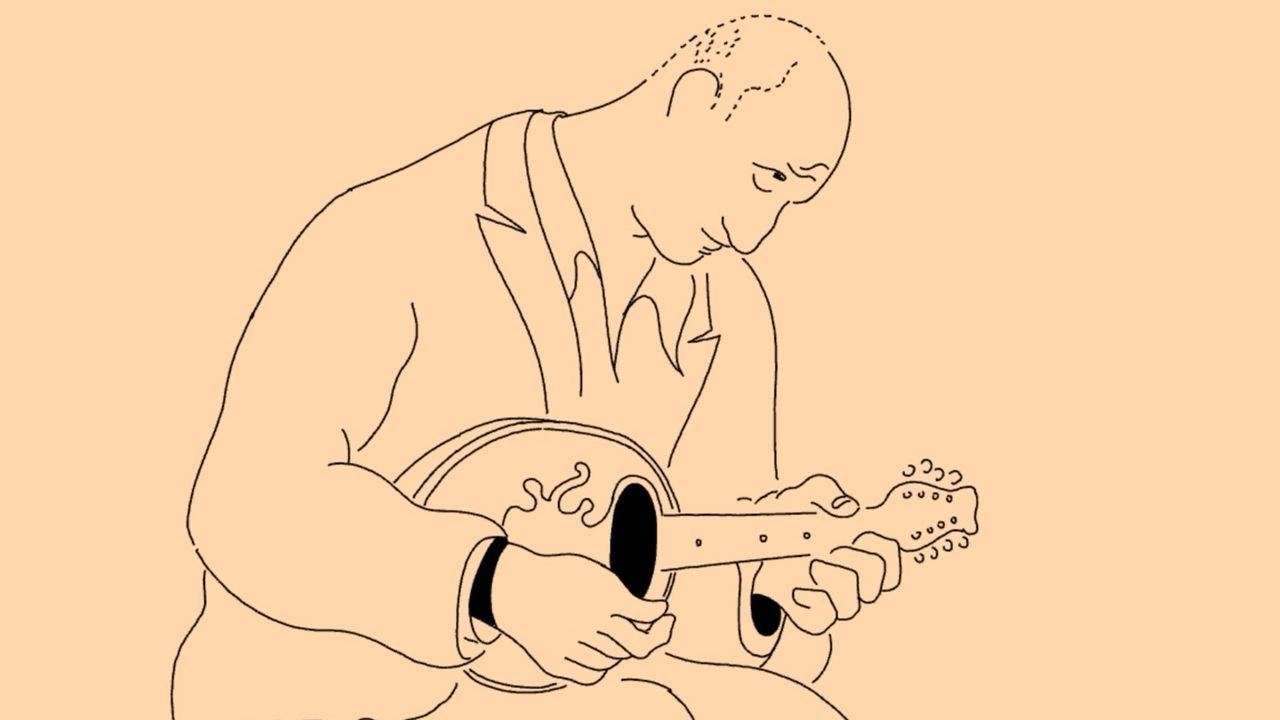
Calace, I discovered, was a Neapolitan workshop that had been making mandolins since 1825, and Raffaele Calace, the grandson of the founder, had been the greatest composer for mandolin in the late nineteenth century. But his music was quite different from the pieces that Paolo introduced me to over the next year, all of which were written in the mid-eighteenth century. With each composer we studied—Emanuele Barbella, Gabriele Leone, Giovanni Battista Gervasio—I dived a little deeper into the history of the instrument, and slowly, unexpectedly, my own attraction to it began to make sense.
Invented in seventeenth-century Italy, during a period of intense experimentation with plucked-string instruments, the mandolin came in various versions and sizes, with four, five, or six strings, single or double. Everything was fluid. There were gut strings, then metallic strings. You could pick with a quill—ostrich feather or raven—or, later, with a tortoiseshell plectrum. By the mid-eighteenth century, the mandolin had become hugely popular in Naples, Rome, and, above all, Paris.
Why? Why was it so successful then but not now? This was the only question I dared ask, sitting in on a seminar at the Milan Conservatory. The teacher was Orlandi himself, both an authority on the history of the instrument and a virtuoso performer. Because the mandolin, unlike the violin, he said, quoting from Leone’s method book, published in 1768, “can tolerate mediocrity.” Music was overwhelmingly domestic at that time. There were no concert halls, and, if people wanted music, they had to make it themselves, in houses where perhaps only one room was heated. A poorly bowed violin screeched. Since it had no frets, learners were frequently off pitch. Even played badly, the fretted mandolin was pleasant and relatively quiet.
Given these circumstances, most of the music written for mandolin (eighty-five volumes were published in Paris between 1761 and 1783) was intended for amateurs, often women. The playing position was thought more decorous than the position for the violin, and the mandolin itself was visually attractive, appearing as a fashion accessory in any number of paintings. An instrument made “pour les Dames,” Gervasio noted on the title page of his method book. The dominant composition was the intimate duet; often, mandolins were made and sold as twins, to be played together. Noble families, Orlandi tells his students, sometimes hired musicians to accompany their amateur efforts.
In the seventeen-seventies, Gervasio composed six duets dedicated to his student the Princess of Prussia. I remember the rush of excitement the first time I managed to get through one of these with Paolo. The mandolins weave intricate patterns together, in counterpoint or unison. Everything is light, zippy, and gently ironic. In the fun of it all, I simply forgot to be nervous.
“You need to work on your expression,” Paolo observed with a sigh.
The fact that the mandolin is easy on the ear doesn’t mean that it is easy to play. Leone taught and codified dozens of complicated pick-stroke combinations, to give depth and expression. “This artist’s skill was astonishing and he was a genuine success,” a review of Leone’s performance at a concert in Paris in 1766 enthused but added ominously, “which was all the more flattering for him because his chosen instrument is not loud compared to the size of the venue.” The era of the concert hall was at hand, and the same qualities that had made the mandolin attractive at home now put it at a disadvantage. The violin and other stringed instruments were redesigned to improve projection and volume. Attempts were made to do the same for the mandolin, but they were never enough. The fact that the instrument was popular with amateurs, particularly in Naples, and often purchased as a souvenir by tourists led to its being disparaged by the state-sponsored academies. So, in a general process of professionalization that changed the way that music was experienced, raising standards while widening the gap between expert and amateur, the mandolin fell out of fashion. Beethoven’s lovely duets for mandolin and harpsichord, written in the seventeen-nineties “pour la belle Josephine,” the wife of a Bohemian nobleman, were not published or publicly performed in his lifetime. By the mid-nineteenth century, the instrument and the music written for it had been largely forgotten—to the point, Berlioz complained, that it was hard to find a mandolinist to perform the serenade in Mozart’s “Don Giovanni.”

