
The Grammys have long been a dependable engine of outrage. Every year, it seemed, one humiliation or another would seize the ceremony, such as when Macklemore defeated Drake, Kanye West, Kendrick Lamar, and Jay-Z for Best Rap Album, in 2014, or when, the year before, the band Fun. beat out Frank Ocean for Best New Artist. All the way back in 2002, the “O Brother, Where Art Thou?” soundtrack somehow won Album of the Year instead of OutKast’s “Stankonia”—a decision that aged poorly even before presenter Janet Jackson had finished reading it off the card. Throughout the Grammys’ nearly seventy-year history, the Recording Academy has disproportionately favored the very white, the very male, and the very old, consistently rewarding legacy acts and industry darlings rather than the year’s most accomplished, essential music. In 2018, Neil Portnow, who was then the president of the Academy, suggested that women performers needed to “step up” if they wanted to win more awards. The comment confirmed what everyone already knew: the Grammys voting body was an out-of-touch boys club whose biases reflected an institution on the brink of irrelevance. (What else could explain Beck beating Beyoncé, in 2015, for best album?) When Portnow left his post, in 2019, his replacement, Deborah Dugan, accused the Academy of vote-fixing and mismanaging finances, which the Academy denied; she was put on leave and then eventually let go. In the aftermath of these scandals, the Grammys have been on something of an apology tour, signalling to audiences and artists alike that they’ve heard the criticisms and they know. They know!
Heading into Sunday night’s event, in Los Angeles, the Grammys were surprisingly short on salacious story lines. If one of the more compelling reasons to tune in to the show is to see just how wrong the Academy is going to get it, then this year’s ceremony promised to be a bit of a snoozer. The “big four” categories had few snubs; its nominees included preëminent stars such as Bad Bunny, Billie Eilish, Chappell Roan, Justin Bieber, Lady Gaga, and Sabrina Carpenter. There were also three rap albums contending for Album of the Year—Clipse’s “Let God Sort Em Out,” Kendrick Lamar’s “GNX,” and Tyler, the Creator’s “Chromakopia”—the most nods the genre has ever received in the category. Adele, Beyoncé, and Taylor Swift, meanwhile, would not be around to generate buzz over rivalries and record-breaking, and no major stars were sitting out the ceremony in protest, as Drake, Ocean, and the Weeknd have in the past. Would Sunday’s telecast actually be an accurate reflection of the year in commercial, major-label music? After decades of alleged corruption and catastrophic choices, was the Academy finally going to get it right?
Thankfully for the Grammys, Bad Bunny brought enough narrative intrigue with him to carry the ceremony. Aside from being the first Spanish-language artist to be nominated at once for Album, Song, and Record of the Year, the Puerto Rican superstar is scheduled to perform at the Super Bowl halftime show, on Sunday. It’s the first time that the main act will be performed entirely in Spanish, something the political right has deemed disgraceful. Kristi Noem, the Secretary of Homeland Security, said that agents from Immigration and Customs Enforcement would “be all over” the Super Bowl, and D.H.S. adviser Corey Lewandowski scolded the N.F.L. for selecting “somebody who just seems to hate America so much.” (President Trump claimed not to know who Bad Bunny was, although he said the prospect of a Bad Bunny halftime show was “absolutely ridiculous.”) Bad Bunny has openly criticized the Trump Administration’s immigration policies, calling out the President himself and the malevolent militarization of ICE. Once again, the Grammys were at the heart of a politically charged moment in which its awards meant more than mere recognition—its choices would function as a cultural bellwether, a comment on where the industry stands on one of the most pressing human-rights issues of our time.
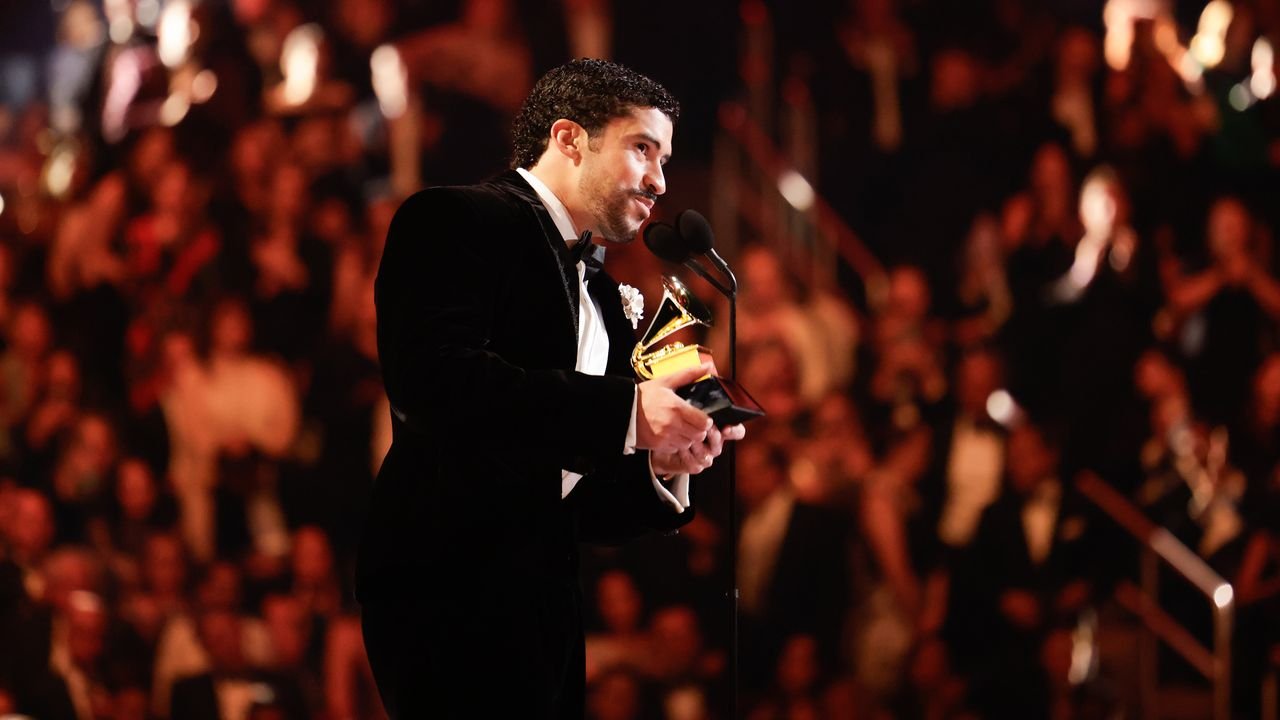
As the festivities began, it became clear that Bad Bunny would indeed serve as the night’s center of gravity. The show’s competent yet miraculously unfunny host, Trevor Noah, cozied up to Bad Bunny at his table and begged him to perform—a ploy, perhaps, to remind the audience that the real performance was soon to come, at the Super Bowl. Early in the evening, when Bad Bunny’s album “DeBÍ TiRAR MáS FOToS” was awarded Best Música Urbana Album, his acceptance speech opened with a rousing call to action: “ICE out,” he declared. (Artists from Carole King to Bieber wore pins that said the same.) In a night heavy on political statements but short on overt political performativity, his message was sharp and clear: “We’re not savage. We’re not animals. We’re not aliens. We are humans, and we are Americans.” Earlier, Billie Eilish—who, preposterously, won Song of the Year for “Wildflower,” a track from last year’s Grammy-nominated album “Hit Me Hard and Soft” that had been repackaged as a single, allowing it to be included in this year’s awards—affirmed, during her acceptance speech, that “no one is illegal on stolen land.” But it was Bad Bunny’s protestations that reverberated the loudest. “The hate gets more powerful with more hate,” he said. “The only thing that is more powerful than hate is love. So, please, we need to be different.”

